Estimated read time: 18 min
Wholesale Fulfillment Problems That Create Distribution Pressure
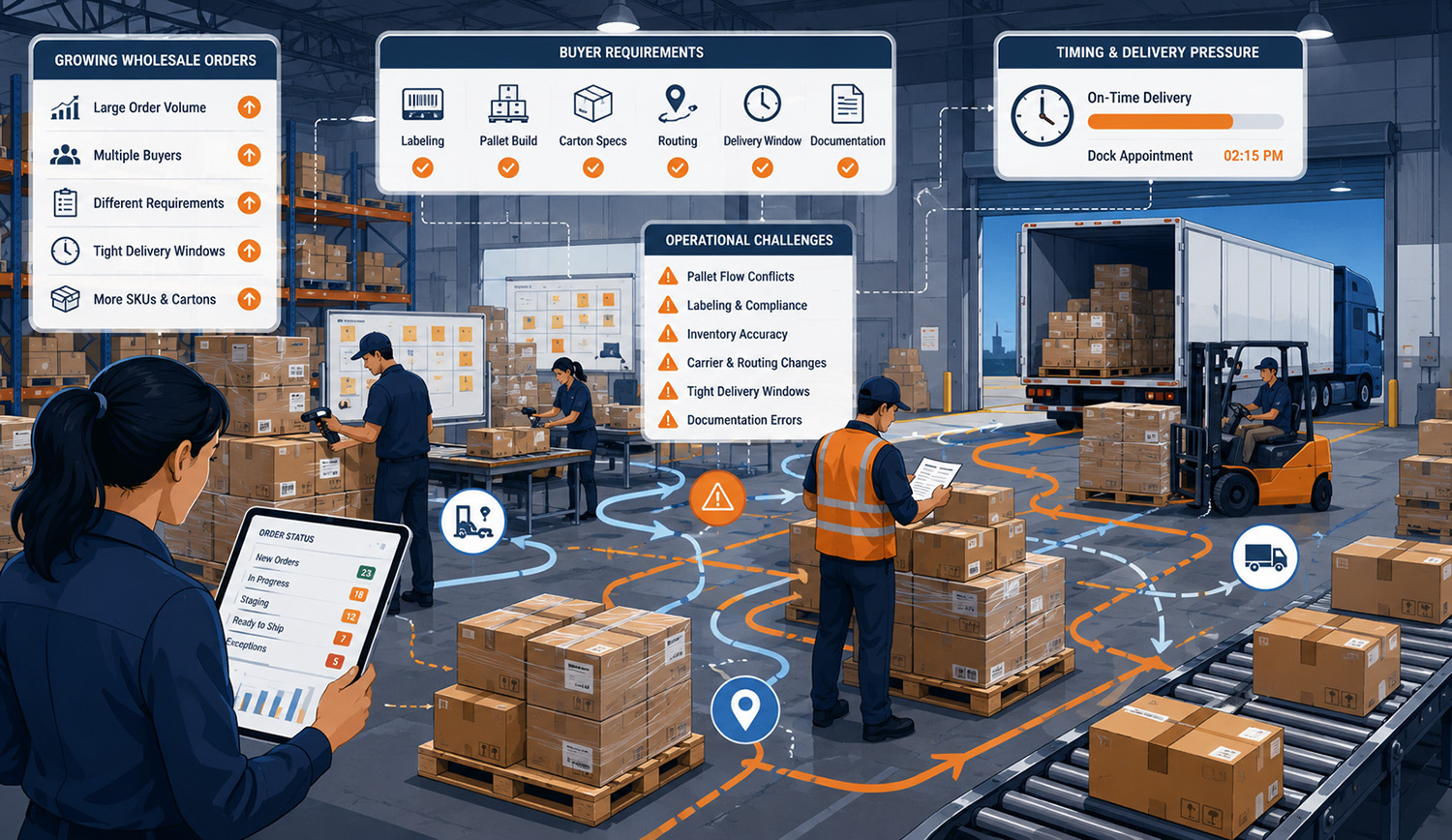
Wholesale fulfillment problems often appear when growing brands move from parcel-based ecommerce fulfillment into larger B2B, distributor, retailer, or wholesale order execution. This guide explains why larger purchase orders can create distribution pressure across inventory readiness, pallet staging, carton preparation, buyer requirements, LTL freight coordination, shipping damage risk, margin control, and daily DTC fulfillment.
Key Takeaway
Wholesale fulfillment problems usually begin before shipping. They appear when inventory readiness, carton preparation, pallet staging, buyer requirements, and LTL freight coordination are not mature enough to support larger B2B orders alongside daily ecommerce fulfillment.
When Wholesale Fulfillment Creates Distribution Pressure
The purchase order arrives.
Your buyer wants the product. The quantity is larger. The opportunity is real. What started as a growth moment now has to become an operating plan.
At first, it may feel like the hard part is over. Your product earned the interest. Your sales team opened the door. Your brand has a chance to move from ecommerce momentum into wholesale growth.
Then the warehouse questions start.
Can your shipping area handle pallets, not just parcels?
Do you have enough dock space for larger outbound freight?
Can your team keep DTC orders moving while preparing a wholesale shipment?
Do you have the forklifts, labor, staging space, carrier relationships, and paperwork control to support the order without disrupting the rest of the business?
That is where wholesale fulfillment begins to feel different.
Wholesale fulfillment problems are the inventory, preparation, staging, documentation, freight, and coordination issues that appear when a brand moves from parcel-based ecommerce orders into larger B2B, retailer, distributor, or wholesale shipments.
In the previous guide on B2B fulfillment services, we looked at how growing brands move from individual ecommerce orders into larger wholesale, distributor, retailer, and business-buyer fulfillment workflows. That first step is exciting because it shows your product has traction and your company has earned a bigger opportunity.
But once the order moves from sales conversation to warehouse execution, the pressure changes.
Your operation is no longer only shipping direct-to-consumer orders through a parcel workflow. Now your team may need to prepare cartons, organize case packs, stage pallets, coordinate LTL freight, follow buyer requirements, manage delivery windows, and protect the ecommerce orders that still have to leave the building that same day.
That is the hidden challenge.
Wholesale growth does not pause your DTC business. It adds another operating lane on top of it.
Your parcel shipping process may be working well. Your team may know how to pick, pack, label, and ship individual customer orders. But B2B and wholesale fulfillment can require a different setup. The order may need pallet movement, dock scheduling, LTL carrier coordination, freight insurance decisions, bills of lading, routing instructions, delivery appointments, and stronger staging discipline before the shipment ever leaves the warehouse.
Those capabilities do not appear overnight.
Carrier relationships take time to build. LTL rates may be expensive when volume is low. Shipping damage becomes a bigger concern when products move by pallet or through a freight network. Paperwork gets more complex. Warehouse staff may need different handling experience. Good labor can be hard to find. Staff turnover can make the process inconsistent. A warehouse built around parcel flow may not have enough dock doors, forklifts, or staging space to move larger orders efficiently.
That does not mean your brand is failing.
It means your company has reached a more demanding stage of growth.
This is where wholesale distribution pressure begins to show up. The product may be available, but is it ready to move by carton, case, pallet, or LTL shipment? The buyer may be excited, but are the routing instructions clear? The order may be approved, but can your team prepare it without slowing down daily ecommerce fulfillment?
These questions matter because the pressure does not stay in one place.
A pallet that is not staged on time can affect the dock.
A missing label can affect the carrier handoff.
An unclear carton count can affect the buyer’s receiving process.
A damaged freight shipment can affect margin and confidence.
A rushed wholesale order can pull labor away from DTC orders that still need to ship.
One larger order can start competing with the operation that built your brand in the first place.
That is what makes wholesale fulfillment problems so important to understand. They are not always caused by one dramatic failure. They often come from small operational gaps that stack together: parcel workflows being stretched into freight workflows, limited dock capacity, not enough forklift support, unclear paperwork, weak staging, expensive LTL options, shipping damage risk, and manual coordination across teams.
One gap creates friction.
Several gaps create pressure.
Repeated gaps create risk.
For your brand, the danger is not only that one wholesale order becomes harder to ship. The larger danger is that growth starts pulling your operation in two directions. Your DTC customers still expect accurate, timely parcel fulfillment. Your wholesale buyer expects larger-order execution, freight coordination, and receiving-ready preparation.
Both sides matter.
If your team has to choose between keeping ecommerce orders moving and getting a wholesale order out the door, the fulfillment model is already under strain.
Wholesale fulfillment problems grow when larger orders, pallet flow, buyer requirements, LTL freight coordination, delivery timing, and existing DTC fulfillment demands begin increasing together.
By the time the pressure reaches the dock, the problem is already in motion.
Your team is trying to protect the ecommerce orders that built the business while also proving your company can support larger wholesale opportunities. That is the moment the operation has to mature, because the next order may be bigger, the buyer expectations may be stricter, and the margin for last-minute coordination may be smaller.
Why Wholesale Fulfillment Problems Start Before Shipping
By the time a wholesale shipment reaches the dock, the pressure is already visible.
The carrier window is getting closer. The pallet still needs to be wrapped. One carton count needs to be checked again. The buyer’s routing instructions are sitting in an email thread. DTC orders are still moving through the parcel station. Someone is asking whether the shipment needs an appointment, whether the freight class is correct, whether insurance makes sense, and whether the paperwork is complete.
It can look like a shipping problem.
Most of the time, it started earlier.
Wholesale fulfillment problems often begin before the truck arrives because the order has to be prepared differently from a standard ecommerce shipment. Your team is not only picking product and printing parcel labels. They may be trying to confirm purchase order details, pull cartons from multiple locations, separate SKUs, prepare case packs, build pallets, verify counts, create a bill of lading, coordinate LTL freight, and still keep regular customer orders moving.
That is where the readiness gap appears.
Your inventory may be in the building, but that does not mean it is ready for wholesale fulfillment. Product can be physically available and still not be ready to move. It may need to be located, counted, inspected, pulled, staged, labeled, palletized, wrapped, documented, and matched to the buyer’s receiving expectations.
That gap matters because wholesale buyers are not only receiving product. They are receiving the result of your process.
If the process is unclear, the buyer feels it.
A carton count error may create receiving confusion. A missing label may slow down the buyer’s dock. A poorly staged pallet may create handling risk. A late carrier pickup may affect delivery timing. A paperwork issue may delay the freight handoff. A rushed team may make mistakes that would have been avoided if the order had been prepared earlier.
The shipment may leave the warehouse, but the pressure travels with it.
This is why inventory readiness is one of the first pressure points in wholesale fulfillment. Strong inventory control is not just a number in a system. It affects whether your team can trust what is available, prepare orders correctly, and execute without constant manual checking.
For wholesale orders, that trust becomes even more important.
Your team needs to know what is available, where it is located, how it should be picked, whether it moves by unit, carton, case, pallet, LTL shipment, or truckload, and what the buyer expects before the freight leaves the warehouse. When those answers are unclear, the operation starts relying on people to solve problems in real time.
That can work once, but it becomes harder when order volume grows.
Paper trails also become more important. In ecommerce fulfillment services, the system may push an order, generate a label, and move the package through parcel shipping. In wholesale fulfillment, the order may involve purchase orders, buyer instructions, routing requirements, packing lists, bills of lading, delivery appointments, accessorial decisions, carrier communication, and internal notes that must all stay aligned.
When that information lives across emails, spreadsheets, printed notes, and conversations, the coordination bottleneck starts to form.
The warehouse team may be waiting on instructions. The shipping team may be waiting on freight details. The sales team may be answering buyer questions. Customer service may be trying to provide updates. Leadership may be watching the order because it represents a larger account opportunity.
Everyone is trying to help.
But without a clear fulfillment process, more people can also mean more handoffs, more interpretation, and more room for error.
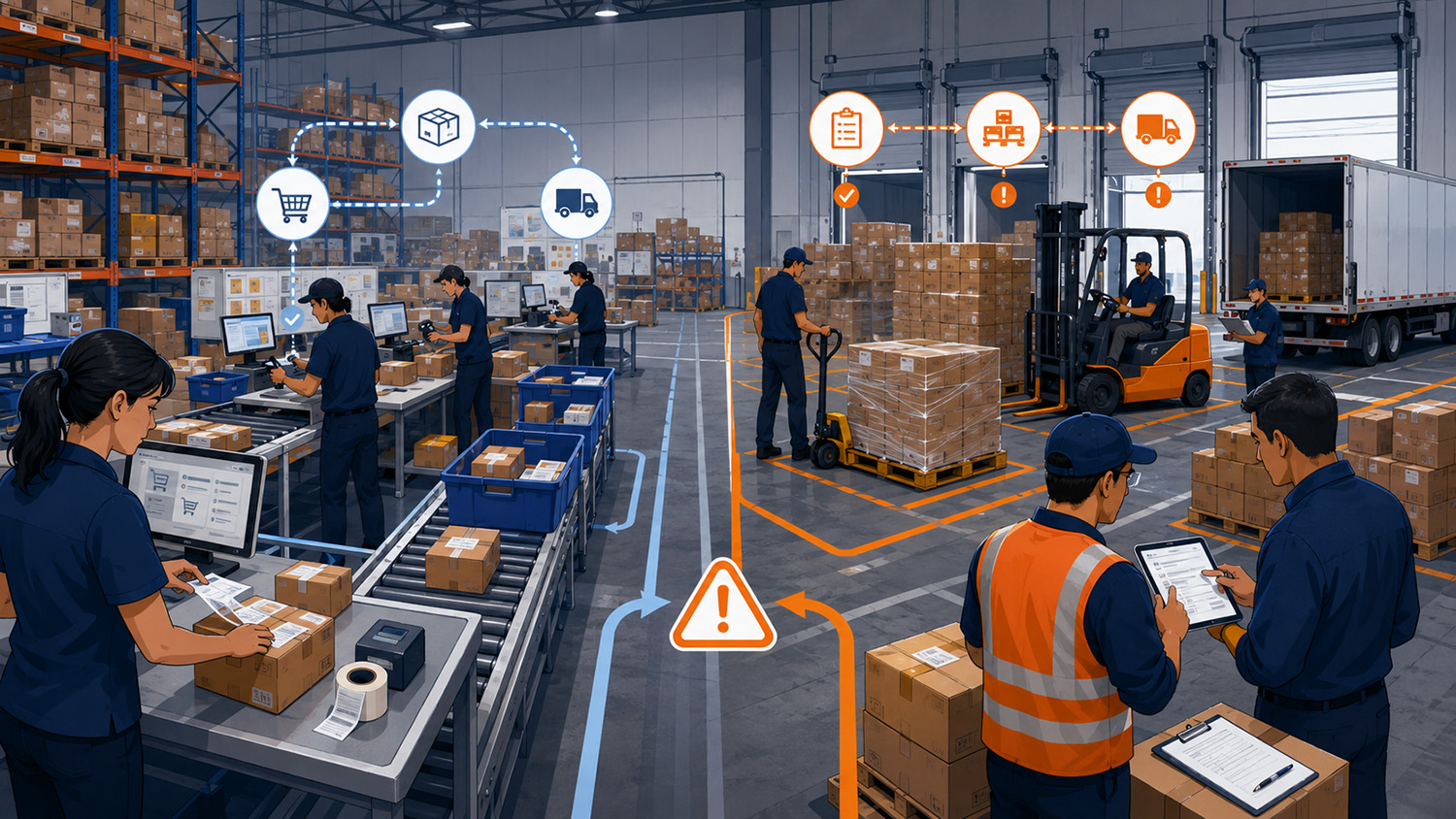
The same thing can happen with physical warehouse flow. A warehouse that works well for parcel shipping may not be set up for pallet movement. If your operation only has limited dock space, limited forklifts, limited staging area, or limited experienced freight staff, wholesale orders can create pressure before the product ever reaches the truck.
A parcel station can process many small orders in a steady rhythm. A wholesale order can interrupt that rhythm.
It may need floor space for staging. It may need a forklift at the same time receiving needs that forklift. It may need a dock door when inbound freight is arriving. It may need staff who understand pallet handling, freight prep, and damage prevention. It may need LTL carrier coordination that your team does not yet have enough volume or relationships to optimize.
That is why wholesale fulfillment problems are rarely just about shipping late.
Delay may be the symptom, but the real issue is often readiness.
Inventory readiness.
Paperwork readiness.
Labor readiness.
Dock readiness.
Carrier readiness.
Buyer requirement readiness.
When any of those pieces are missing, the operation has to improvise.
Improvising can feel productive in the moment. Someone finds the missing carton. Someone confirms the count. Someone calls the carrier. Someone reprints the paperwork. Someone moves the pallet. Someone stays late to keep the order on track.
But the business pays for that improvisation.
It pays through extra labor, slower DTC flow, more management attention, more freight uncertainty, more risk of shipping damage, and more pressure on the people trying to hold the process together.
Wholesale fulfillment problems start before shipping because shipping is only the final handoff. The order has to be ready before that handoff happens.
If the product is not organized, the carton count is unclear, the pallet is not staged, the paperwork is not aligned, the dock is not ready, or the LTL plan is still being figured out, the shipping moment becomes the place where every earlier gap shows up at once.
That is the danger of the readiness gap.
The order may look like it is almost done because the product is in the warehouse. But wholesale fulfillment is not finished when the product exists. It is ready when the order can move through the buyer’s process with accuracy, timing, documentation, and control.
How Pallet Staging, Carton Preparation, and Buyer Requirements Create Bottlenecks
Wholesale fulfillment gets harder when the order stops moving like a parcel shipment and starts moving like a business shipment.
Your team may still be working with the same product, the same warehouse, and the same people. But the order profile has changed. Instead of one item going into one box for one customer, the order may involve multiple cartons, case packs, mixed SKUs, pallet building, labels, packing lists, routing instructions, delivery appointments, and LTL freight coordination.
That is when the requirement stack begins to build.
Each requirement may seem manageable on its own. The buyer needs carton labels. The order needs a packing list. The pallet needs to be wrapped. The shipment needs a bill of lading. The LTL carrier needs pickup details. The receiving team needs the freight to arrive within a delivery window. The buyer expects the order to match the purchase order exactly.
None of those steps are unusual in wholesale fulfillment.
The problem begins when all of them have to happen at the same time, inside an operation that was originally built for ecommerce parcel flow.
That is where bottlenecks start.
Carton preparation is one of the first places pressure shows up. Your team may need to confirm carton counts, separate SKUs, organize case packs, check quantities against the purchase order, and make sure the order is packed in a way the buyer can receive. If the order details are unclear, the warehouse has to pause and verify before the work can continue.
That pause may look small, but in a busy operation, small pauses stack quickly.
One person checks the purchase order. Another person looks for missing cartons. Someone else asks whether the SKU should be separated or combined. A supervisor confirms whether labels are required. The shipping team waits because the pallet cannot be wrapped until the carton count is final.
Now the order is not just being fulfilled. It is being interpreted.
Pallet staging creates another pressure point. A palletized shipment needs space, equipment, timing, and handling discipline. Product has to be pulled, grouped, stacked, wrapped, labeled, and staged in a way that supports the outbound handoff. If your warehouse has limited staging space, limited dock doors, or only a few forklifts, the wholesale order can start competing with other work.
Receiving may need the forklift. DTC fulfillment may need the same labor. Another outbound shipment may need the same dock area. A carrier may arrive before the pallet is fully ready.
This is how pallet flow turns into a coordination bottleneck.
The product may be available. The team may be capable. The buyer may be reasonable. But the operation still needs enough structure to move the work through the warehouse without creating traffic jams.
As covered in the EOS guide to warehouse storage and distribution services, storage only creates value when inventory can move cleanly into the next stage of work. For wholesale fulfillment, that next stage may involve carton preparation, pallet staging, buyer requirements, freight coordination, and outbound distribution.
Wholesale fulfillment also introduces more buyer-specific requirements. Some buyers may need specific labels, carton organization, routing steps, delivery windows, appointment scheduling, or documentation. Others may have receiving preferences that are not difficult, but still need to be followed consistently.
The requirement itself may not be the problem.
The problem is when the requirement is discovered too late.
If the routing instructions arrive after the pallet is built, the pallet may need to be adjusted. If the buyer requires a specific label format after cartons are already sealed, the team may need to reopen or relabel. If the carrier pickup is scheduled before the order is fully staged, the dock handoff becomes rushed. If the delivery window is missed, the buyer may experience the issue even though the problem started inside the warehouse days earlier.
That is where wholesale fulfillment problems become dangerous.
The order can look almost complete while still being vulnerable. The cartons may be pulled, but not verified. The pallet may be built, but not labeled. The paperwork may exist, but not match the shipment. The carrier may be booked, but not aligned with the buyer’s receiving window. The inventory may be available, but not prepared for the buyer’s process.
This is the difference between product movement and wholesale execution.
A wholesale order does not just move through the warehouse. It has to be prepared for the buyer’s process.
LTL freight adds another layer. Unlike parcel shipping, LTL shipping depends on freight class, dimensions, weight, pallet quality, carrier selection, pickup scheduling, accessorial decisions, claims risk, and delivery expectations. If your team is new to LTL or shipping at lower volume, rates may be higher, options may be limited, and carrier relationships may not be mature yet.
That creates pressure on both cost and execution.
The shipment needs to move on time, but the business also has to protect margin. The product needs to arrive safely, but shipping insurance may not be simple or cost-effective. The carrier needs accurate information, but the warehouse may still be finalizing pallet dimensions and shipment details. The buyer expects a professional freight experience, but your internal team may still be learning the process.
This is where the hidden margin leak can begin.
Extra handling takes labor. Rework takes time. Freight errors create cost. Damage creates claims and buyer frustration. Missed pickups create delays. Poor pallet preparation increases risk. Low-volume LTL rates can reduce profitability.
The sale may look strong on paper, but the fulfillment process can quietly eat into the value of the order.
In real warehouse operations, the issue is rarely one isolated mistake. It is the way inventory readiness, labor availability, staging space, dock timing, carrier coordination, and buyer requirements all compete for attention at the same time.
That is why pallet staging, carton preparation, and buyer requirements matter so much. They are not just warehouse details. They are the operating steps that determine whether wholesale fulfillment feels controlled or reactive.
When those steps are aligned, the order can move with confidence. When they are not aligned, the warehouse becomes the place where every requirement, exception, and timing issue collides.
Your team may still get the order out.
But if every wholesale shipment depends on extra checking, extra labor, extra emails, extra approvals, and extra recovery work, the operation is telling you something important.
The business is no longer dealing with a one-time fulfillment task. It is dealing with a repeatability problem.
What Wholesale Fulfillment Problems Cost Growing Brands
Wholesale fulfillment problems do not stay inside the warehouse. They move into cost, buyer confidence, team workload, and the next sales conversation.
At first, the cost may not look dramatic. Your team spends extra time checking a purchase order. Someone rebuilds a pallet. A supervisor confirms carton counts. The shipping team calls another carrier. Customer service sends one more update. The warehouse stays late to protect the order.
The shipment may still move, but the business still pays for the pressure.
It pays through labor that was not planned, time that could have supported other orders, freight decisions made under pressure, and management attention pulled into a process that should have been more predictable. One larger order can quietly consume more of the operation than expected.
That is where the hidden margin leak begins.
A wholesale order may look profitable on the sales side, but fulfillment friction can reduce the value of that order before the buyer ever receives it. Extra handling, rework, rushed staging, LTL rate uncertainty, accessorial charges, shipping damage, missed pickup windows, and manual follow-up can all cut into margin.
The danger is that these costs do not always show up as one obvious loss. They show up as small drains across the operation.
A worker spends an extra hour finding cartons. A forklift gets pulled away from receiving. DTC orders wait while the wholesale order gets fixed. A pallet needs to be rebuilt because the instructions changed. A freight shipment costs more than expected because the carrier relationship is still new. A damaged shipment creates a claim, a replacement, or a difficult buyer conversation.
Each issue may be explainable. Together, they create drag.
For a growing brand, that drag matters because wholesale growth is supposed to create momentum. Larger buyers should help the business scale. But when the fulfillment model is not ready, every larger order can feel like a special project instead of a repeatable process.
That affects more than warehouse efficiency. It affects your team.
Your shipping department may already be responsible for daily parcel flow. Your warehouse staff may be balancing receiving, picking, packing, staging, replenishment, and customer orders. If wholesale fulfillment adds pallet building, LTL coordination, routing instructions, delivery appointments, and extra paperwork without more structure, the team can become reactive fast.
Good warehouse staff is hard to find. Staff turnover can make consistency harder. A process that depends on one experienced person remembering every buyer requirement becomes fragile when that person is out, overloaded, or no longer with the company.
That is how fulfillment pressure becomes business risk.
The risk is not only that one order ships late. The risk is that your operation becomes harder to trust as order complexity increases.
Your buyer may not see the labor shortage, limited dock space, forklift conflict, LTL rate challenge, or paperwork confusion behind the scenes. They only see the result: whether the order arrives correctly, cartons are organized, labels are clear, pallets are intact, delivery timing is dependable, and communication stays professional when something changes.
That creates the buyer confidence risk.
A buyer may love your product and still hesitate if the fulfillment experience feels difficult. A distributor may place the first order but slow down the second. A retailer may test your brand but hold back from expanding. A business customer may question whether your company can support larger volume if the first larger shipment creates too much friction.
The sale opens the door. Fulfillment determines whether the opportunity can repeat.
This is why wholesale fulfillment problems can challenge growth more than they first appear. They do not just affect the current shipment. They can affect how confidently your company pursues the next order, how strongly your buyer trusts the process, and how much internal strain your team can absorb before growth starts feeling unstable.
As covered in the guide to fulfillment problems across multiple sales channels, fulfillment issues rarely stay isolated. They can spread into customer experience, team workload, operational confidence, and future growth opportunities.
That instability can show up in several ways. Sales may become more cautious about promising larger orders. Operations may push back because the warehouse is already stretched. Finance may question whether the margin is worth the extra handling and freight cost. Leadership may realize that the company has product demand, but not enough fulfillment structure to support the next stage.
That is a hard place for a growing brand to be.
The market is asking for more. Your buyer may be ready. Your product may be strong. But the operation behind the order has to prove that growth can be supported without creating chaos inside the business.
Wholesale fulfillment pressure can make a company feel like it is winning and struggling at the same time.
That is why the cost of inaction matters.
If the process stays the same, each new wholesale order can add more pressure to the same weak points: limited staging space, unclear inventory readiness, paper-heavy coordination, immature LTL relationships, overloaded staff, inconsistent handling, and a fulfillment model still built mostly around parcel orders.
The business may keep pushing orders out the door, but the pressure keeps returning.
At some point, the question becomes bigger than whether your team can ship the next order. The real question is whether your fulfillment model can protect the buyer relationship, the margin, the team, and the growth opportunity at the same time.
Why B2B Distribution Pressure Means Your Fulfillment Model Has to Mature
Wholesale fulfillment pressure is not a sign your brand should slow down. It is usually a sign your operation has outgrown the fulfillment model that got you here.
At this stage, demand already exists. Buyers are interested. Purchase orders are real. Your ecommerce business may still be shipping daily DTC orders successfully. But now the same warehouse, staff, docks, and shipping workflows are being asked to support a very different type of growth.
That shift changes the conversation.
The question is no longer, “Can we get this wholesale order out the door?”
The better question is, “Can we support this type of order repeatedly without disrupting the rest of the business?”
Many brands can force a large wholesale shipment through with enough effort. Teams stay late. Pallets get rebuilt. Freight carriers are chased down. Paperwork is checked multiple times. Extra communication protects the buyer relationship.
That effort matters, but effort alone is not a scalable fulfillment strategy.
As wholesale channels grow, brands need a repeatable system for managing inventory readiness, carton prep, pallet staging, buyer routing and compliance requirements, freight coordination, delivery timing, and ongoing DTC fulfillment at the same time.
That is the maturity shift.
Without operational structure, the same fulfillment problems continue to surface:
- Inventory is not fully ready when orders arrive
- Dock and staging space become bottlenecks
- Carton labeling and paperwork create delays
- LTL freight coordination stays reactive and expensive
- Teams rely on manual communication to keep orders moving
- DTC fulfillment slows down during large wholesale pushes
At first, these issues can feel like normal growing pains. Over time, they become operational liabilities that affect margins, buyer confidence, staff stability, and the company’s ability to pursue larger retail or wholesale accounts.
This is why B2B fulfillment pressure deserves attention early.
Most brands do not need an enterprise logistics department overnight. But they do need to recognize when their current operation is being asked to handle work it was never designed to support consistently.
Once that becomes clear, the focus shifts from reacting to wholesale pressure toward building a fulfillment model that can absorb it.
A mature B2B distribution operation creates more control across the entire process:
- Inventory is prepared before orders become urgent
- Cartons are verified before pallets are staged
- Buyer routing and compliance requirements are documented early
- Freight coordination happens before carrier deadlines tighten
- DTC fulfillment continues moving while wholesale orders are processed
That is how fulfillment starts supporting growth instead of fighting against it.
The goal is not simply shipping larger orders. The goal is building a fulfillment process capable of supporting larger buyer relationships over time.
Wholesale buyers are evaluating more than your product. They are evaluating whether your company can operate as a dependable supply partner. They want confidence that your team can repeat the process, scale with demand, and meet the operational expectations that come with B2B distribution.
When your fulfillment model matures, the pressure becomes manageable. Teams gain structure. Buyers gain confidence. Margins become easier to protect. Ecommerce fulfillment remains more stable while wholesale demand grows.
That is the real opportunity behind distribution pressure.
It is not necessarily a warning sign. Often, it is the signal that your business is ready for a stronger logistics model.
In the next guide, we will break down what that stronger model requires and how the right B2B distribution logistics partner can help growing brands manage wholesale fulfillment, coordinate freight, maintain inventory visibility, protect buyer relationships, and build a scalable operation designed for repeatable growth.
Frequently Asked Questions About Wholesale Fulfillment Problems
What are wholesale fulfillment problems?
Wholesale fulfillment problems are operational issues that appear when a business starts shipping larger B2B, distributor, retailer, or wholesale orders. These problems can include unclear inventory readiness, carton count errors, pallet staging delays, labeling issues, LTL freight coordination challenges, shipping damage, paperwork confusion, and difficulty keeping DTC orders moving while larger orders are prepared.
For growing brands, wholesale fulfillment problems often show up when an operation built for parcel shipping is suddenly asked to support pallets, freight, buyer requirements, and larger outbound distribution workflows.
Why does wholesale fulfillment create more pressure than ecommerce fulfillment?
Wholesale fulfillment creates more pressure because the order profile changes. Ecommerce fulfillment usually focuses on individual customer orders, parcel shipping, and direct-to-consumer delivery. Wholesale fulfillment may involve purchase orders, cartons, case packs, pallets, routing instructions, delivery windows, bills of lading, LTL freight coordination, and buyer-specific receiving requirements.
If your team is still using a parcel-focused fulfillment model, larger B2B orders can create bottlenecks across labor, dock space, staging, paperwork, and freight coordination.
Related guide: How B2B Fulfillment Services Help Brands Move from Ecommerce Orders to Wholesale Distribution
Why do wholesale fulfillment problems often start before shipping?
Wholesale fulfillment problems often start before shipping because the order has to be prepared correctly before it reaches the dock. Product may be physically available in the warehouse, but that does not mean it is ready for wholesale fulfillment.
Inventory may need to be located, counted, pulled, staged, labeled, palletized, wrapped, documented, and matched to the buyer’s requirements. If those steps are not clear before the carrier arrives, the shipping moment becomes the place where earlier gaps show up all at once.
Related guide: Inventory Control Isn’t Just a Metric — It’s the Heartbeat of 3PL Success
How does LTL freight affect wholesale fulfillment?
LTL freight affects wholesale fulfillment because larger orders often move differently than parcel shipments. LTL shipping may require freight class details, pallet dimensions, weight, carrier selection, pickup scheduling, delivery appointments, accessorial decisions, damage prevention, and freight documentation.
For brands that are new to LTL shipping, rates may be higher, carrier relationships may be limited, and shipment planning may require more coordination. If LTL freight is handled reactively, it can increase cost, delay outbound movement, and create more risk for the buyer relationship.
What makes pallet staging difficult for growing brands?
Pallet staging becomes difficult when a warehouse does not have enough space, dock access, forklift availability, trained labor, or process structure to support larger outbound shipments. A palletized order needs room to be pulled, grouped, stacked, wrapped, labeled, verified, and staged before the carrier arrives.
If the same warehouse is also managing DTC fulfillment, receiving, replenishment, and other outbound orders, pallet staging can quickly compete with daily operations. That is when wholesale fulfillment pressure begins to affect the rest of the business.
Related guide: Warehouse Storage and Distribution Services Explained
How can wholesale fulfillment problems affect buyer confidence?
Wholesale fulfillment problems can affect buyer confidence when orders arrive late, damaged, mislabeled, incomplete, poorly documented, or difficult to receive. A wholesale buyer is not only evaluating the product. They are also evaluating whether your company can operate as a dependable supply partner.
If the first larger order creates too much friction, the buyer may hesitate before placing another order, expanding the account, testing more SKUs, or increasing volume. The sale opens the door, but fulfillment determines whether the opportunity can repeat.
How do wholesale fulfillment problems affect margins?
Wholesale fulfillment problems can reduce margins through extra labor, rework, rushed staging, freight uncertainty, accessorial charges, shipping damage, missed pickup windows, manual follow-up, and inefficient LTL shipping decisions.
These costs may not appear as one obvious loss. Instead, they often show up as small drains across the operation. A large wholesale order may look profitable on paper, but fulfillment friction can quietly reduce the value of the order before the buyer receives it.
When should a brand rethink its wholesale fulfillment model?
A brand should rethink its wholesale fulfillment model when larger orders repeatedly require last-minute coordination, manual inventory checks, rushed pallet preparation, unclear paperwork, reactive freight planning, or extra labor that disrupts normal DTC fulfillment.
One difficult order can usually be solved with effort. Repeated wholesale pressure usually means the operation needs a more mature fulfillment model built for inventory readiness, carton preparation, pallet staging, buyer requirements, freight coordination, and repeatable B2B distribution.
What is the next step after identifying wholesale fulfillment problems?
After identifying wholesale fulfillment problems, the next step is to build a more structured B2B distribution model. That may include better inventory visibility, clearer warehouse processes, earlier buyer requirement review, stronger pallet staging, better LTL freight coordination, and a fulfillment partner that can support larger orders without disrupting daily ecommerce fulfillment.
The next guide explains how the right B2B distribution logistics partner can help growing brands turn wholesale pressure into a more controlled fulfillment model.
Next guide: B2B Distribution Logistics Partner for Wholesale Growth
B2B Distribution Logistics Partner for Wholesale Growth
The next guide explains how the right B2B distribution logistics partner can help growing brands manage wholesale fulfillment, coordinate LTL freight, improve inventory visibility, protect buyer relationships, and build a fulfillment model designed for repeatable growth.
Discover more from Enterprise Order Solutions
Subscribe to get the latest posts sent to your email.