Why Ecommerce Fulfillment Problems Get Worse Across Multiple Sales Channels
Ecommerce fulfillment problems often begin as small operational gaps, but they become more difficult to manage as brands add more orders, more SKUs, more sales channels, and more customer expectations. This guide explains why fulfillment pressure grows across multiple sales channels and how those problems can affect customers, marketplaces, and long-term growth.
Why Ecommerce Fulfillment Problems Start After Growth
In the first guide, we looked at how ecommerce fulfillment services help growing brands move inventory from the warehouse into customer orders.
That stage matters because stored inventory does not create customer satisfaction by itself. Product still has to be picked, packed, labeled, shipped, tracked, and delivered in a way that protects the customer’s trust after checkout.
But once a brand understands how fulfillment works, the next question becomes more serious:
Why do ecommerce fulfillment problems get worse as the business grows?
The answer usually is not that the brand is doing something wrong.
In many cases, the brand is doing exactly what it set out to do. The product is selling. More customers are ordering. New sales channels are opening. The company website is gaining traction. Marketplace listings are creating demand. Advertising is working. The business is moving.
That is the good news.
The challenge is that fulfillment pressure grows quietly behind that momentum.
At low order volume, a team may be able to solve problems with extra effort. Someone checks inventory manually. Someone follows up with the warehouse. Someone rushes a shipment. Someone answers the customer. Someone updates the marketplace. The process may not be perfect, but the business can still keep moving.
Growth changes that.
More orders create more movement. More movement creates more chances for delay, confusion, missed updates, wrong counts, or exception handling. More sales channels create more versions of the same fulfillment promise: ship accurately, ship on time, update tracking, protect the customer experience, and keep the business in good standing.
That is where ecommerce fulfillment problems begin to feel different.
- A late shipment is no longer just one late shipment
- An inventory mismatch is no longer just one warehouse question
- A tracking delay is no longer just one customer email
- A canceled order is no longer just one missed sale
As these issues repeat across channels, fulfillment starts taking up more space inside the business.
The brand still needs to focus on growth: better product photography, stronger videos, improved listings, advertising campaigns, new product development, customer retention, and marketplace expansion. But the team starts getting pulled back into order status checks, inventory questions, shipping delays, customer complaints, and marketplace follow-up.
That is the shift.
The brand is still growing, but fulfillment begins acting less like a support function and more like a daily operational constraint.
This is why ecommerce fulfillment problems can become so frustrating for growing brands. The business may have demand, customers, and opportunity, but the fulfillment model that worked at one stage may not be strong enough for the next one.
Previous guide: How Ecommerce Fulfillment Services Work When Your Brand Starts Growing
Why Every Marketplace Adds More Fulfillment Complexity
At first, adding more sales channels feels like expanding the scoreboard.
A brand that started with its own website may begin selling through Amazon. Then Walmart becomes a growth opportunity. eBay adds another customer base. Wayfair, Home Depot, Lowes, or other retail-connected marketplaces may open doors to larger products, home goods, furniture, appliances, or specialty categories.
Each channel can bring new customers.
But each channel also adds another layer of fulfillment responsibility.
The issue is not that marketplace rules are impossible or that every channel works against the others. The issue is that every marketplace adds its own version of the fulfillment promise:
ship accurately, ship on time, update tracking, manage exceptions, and protect the customer experience.
That sounds simple until the same brand has to execute that promise across several different order flows at the same time.
A website or Shopify order may give the brand more control over the customer relationship. Amazon may create pressure around seller performance, shipping speed, fulfillment method, tracking visibility, cancellation rates, and account health. Walmart may place strong emphasis on fast, reliable shipping and clean order execution. Wayfair, Home Depot, Lowes, and other channels may add product-size concerns, packaging expectations, delivery requirements, returns coordination, and customer communication standards.
Individually, each channel may be manageable.
Together, they create the Channel Maze.
The brand has to know where the order came from, which inventory should fulfill it, what shipping method applies, how quickly it needs to move, what tracking information must be updated, what happens if inventory is not available, and how the customer or marketplace will respond if something goes wrong.
That complexity grows even faster when products are not small, simple, and easy to ship.
Larger items, heavier cartons, furniture, appliances, home goods, and oversized products can create more handling requirements. Packing has to be right. Labels have to be accurate. Carrier selection matters. Damage risk increases. Returns become harder. Delivery experience becomes more visible to the customer.
Now the fulfillment process is not just moving more orders.
It is managing more promises.
This is where many ecommerce brands start to feel the strain. The sales channels are working. Customers are buying. Demand is expanding. But each new channel adds another operational lane that has to stay organized, visible, and on time.
When the operation is not built for that level of complexity, the pressure does not always show up as one major breakdown.
It shows up as small questions that keep repeating:
- Which channel did this order come from?
- Which shipping rule applies?
- Is the inventory actually available?
- Did the warehouse pick the right item?
- Did tracking update correctly?
- What happens if the order misses the cutoff?
- Who is responsible for resolving the exception?
Those questions slow the business down.
And as more channels are added, the fulfillment team is no longer managing one clean workflow. It is managing several versions of the same customer promise, each with its own timing, visibility, and execution requirements.
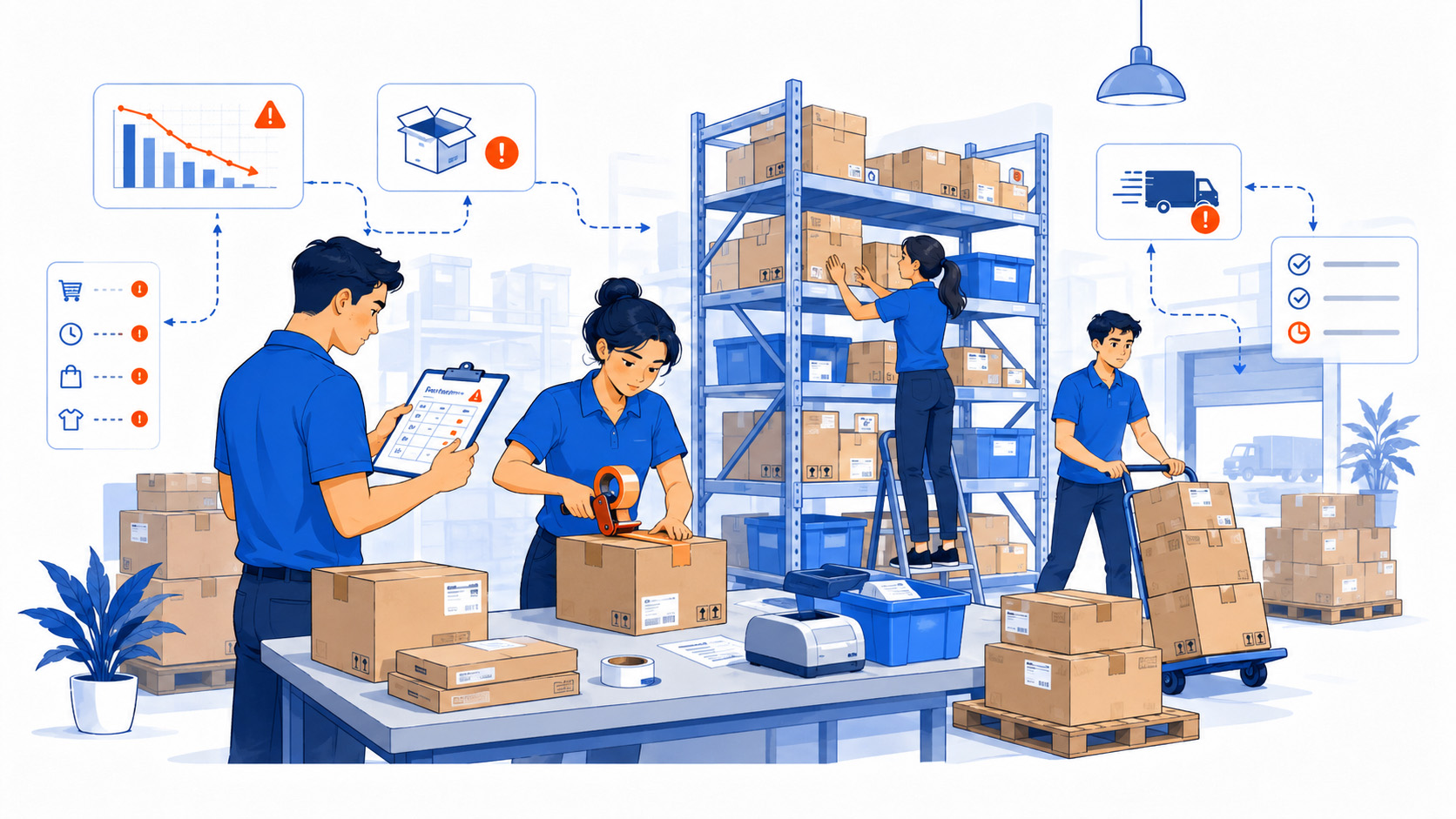
How Ecommerce Shipping Problems Affect Customer Experience
Fulfillment problems do not stay hidden inside the warehouse for long.
At first, the issue may look operational. A pick ticket is delayed. A SKU count is off. A label is created late. A package misses a carrier pickup. A tracking number does not update. A return sits unresolved longer than expected.
Inside the business, those may feel like workflow problems.
To the customer, they feel personal.
The customer does not see the order queue, the warehouse location, the packing station, the carrier cutoff, or the inventory adjustment. They only see what happens after they click “buy.”
- They see whether the order ships on time
- They see whether tracking works
- They see whether the right product arrives
- They see whether the package is damaged
- They see whether customer service can answer their question clearly
That is why ecommerce shipping problems can become customer experience problems so quickly.
A customer may understand that delays happen, but they still expect communication. If tracking does not update, they wonder if the order was actually shipped. If a package arrives late, they may question whether the brand is reliable. If the wrong item arrives, the customer now has to spend their own time fixing a problem they did not create.
That friction matters.
The product may be excellent. The listing may be accurate. The ad campaign may have worked. The customer may have been excited to buy.
But after checkout, fulfillment becomes the brand experience.
This is especially important for ecommerce and DTC brands because the customer relationship is built through trust. Customers are not just buying an item; they are deciding whether the brand feels dependable enough to buy from again.
When fulfillment works, the customer rarely thinks about it.
When fulfillment breaks down, the customer remembers.
That memory can turn into a support ticket, a refund request, a return, a negative review, or hesitation before the next purchase. Even when the problem is eventually resolved, the customer may still feel less confident in the brand.
This is where the Review Monster begins to show up.
- A delayed shipment can become a complaint
- A tracking issue can become a public question
- A damaged delivery can become a poor review
- A wrong item can become a refund request
- A slow response can become a lost customer
For the brand, the painful part is that these problems often do not reflect the quality of the product or the strength of the business. They reflect the pressure building inside the fulfillment process.
That is what makes ecommerce fulfillment problems so costly.
They do not only create warehouse cleanup. They create customer uncertainty.
And once customer uncertainty enters the story, the brand is no longer just managing orders. It is managing trust.
Why Marketplace Fulfillment Issues Can Hurt Account Health
Customer trust is not the only thing at risk when fulfillment problems repeat.
For ecommerce brands selling through marketplaces, fulfillment performance can also affect the health of the selling account.
That is where the pressure gets louder.
- A late shipment is not just a late shipment
- A canceled order is not just a canceled order
- A tracking delay is not just a missing update
- An inventory mismatch is not just a warehouse question
Across marketplace channels, those issues can become performance signals.
Amazon, Walmart, eBay, Wayfair, Home Depot, Lowes, and other sales channels each have their own expectations for order handling, shipping timelines, tracking updates, cancellations, returns, and customer service. The exact standards may vary by platform, but the direction is clear: marketplaces want sellers who can deliver a reliable customer experience.
That means fulfillment problems can create risk beyond the individual order.
- If orders ship late, the brand may have to explain the delay
- If inventory is oversold, the order may need to be canceled
- If tracking does not update, the customer may lose confidence
- If the wrong item ships, the marketplace may see a preventable service failure
- If returns or exceptions drag on, customer frustration can grow
The brand may still be working hard behind the scenes, but marketplaces usually judge the visible outcome.
- Was the order fulfilled correctly?
- Was it shipped on time?
- Was the customer updated?
- Was the issue resolved cleanly?
- Did the transaction protect the customer experience?
This is why marketplace fulfillment issues feel different from ordinary warehouse problems.
Inside the business, a team may see a late order as something they can still fix. But on a marketplace, the issue may already be recorded as part of the seller’s performance history. One mistake may be manageable. Repeated mistakes can start to affect confidence in the account.
That creates a difficult position for the ecommerce brand.
The team is not only trying to satisfy customers. It is also trying to protect marketplace standing, future visibility, and the ability to keep selling through channels that may be driving meaningful revenue.
The pressure compounds because marketplace growth often rewards brands that can execute consistently. More sales can create more opportunity, but more opportunity also creates more orders that must be fulfilled accurately, tracked correctly, and handled within each channel’s expectations.
This is where the Cutoff Clock becomes dangerous.
Every order has a timeline. Every timeline has consequences. Every missed step creates another chance for a fulfillment issue to move from the warehouse floor into the marketplace account.
And once fulfillment problems begin affecting account health, the conversation changes.
The brand is no longer asking only:
“Can we get this order out?”
The brand is asking:
“Can we keep growing without putting our customer experience, marketplace standing, and future sales at risk?”
When Ecommerce Fulfillment Problems Become a Growth Constraint
At some point, the brand can feel the shift.
The problem is no longer one delayed order, one inventory mismatch, one missed tracking update, or one customer asking where their package is.
The problem is that fulfillment pressure has started shaping how the business operates.
The team is working harder, but the operation still feels reactive. Customer service is chasing answers. Marketing is getting interrupted by order issues. Leadership is trying to understand what is happening across inventory, orders, carriers, and sales channels. The warehouse may still be moving product, but the brand has less confidence in whether the fulfillment model can support the next stage of growth.
That is when ecommerce fulfillment problems become a growth constraint.
- The business still has demand
- The products still have value
- Customers are still buying
- The sales channels are still creating opportunity
But growth no longer feels clean.
- Every new campaign may create more order pressure
- Every new marketplace may add more fulfillment requirements
- Every new SKU may create more inventory complexity
- Every seasonal spike may expose another weak point
- Every customer complaint may pull the team back into cleanup mode
The brand wants to move forward, but fulfillment keeps pulling attention backward.
That is the wrong-work trap at its highest level.
Instead of spending time improving product listings, testing new creative, expanding product lines, building customer loyalty, and planning the next growth move, the team spends too much time protecting the current operation from falling behind.
For growing ecommerce brands, that is a serious warning sign.
Fulfillment should support growth. It should not quietly consume the time, focus, and energy needed to create it.
The difficult part is that effort alone can make the problem harder to see. A committed team may keep pushing orders through, answering customers, checking inventory, and fixing exceptions manually. From the outside, the business may still look like it is operating.
But behind the scenes, the team knows the truth.
The model is getting heavier.
The brand is not failing.
The demand is still there.
The customers are still buying.
But the fulfillment operation may be entering a stage where extra effort alone is no longer enough to protect customer experience, marketplace standing, and future growth.
That is where the next question begins:
What does a stronger ecommerce fulfillment model need to look like?
In the next guide, we will look at how the right 3PL fulfillment partner helps ecommerce brands regain control, improve visibility, support marketplace execution, and scale with stronger operational discipline.
Next guide: How a 3PL Fulfillment Partner Helps Ecommerce Brands Scale
Frequently Asked Questions About Ecommerce Fulfillment Problems
What are common ecommerce fulfillment problems?
Common ecommerce fulfillment problems include delayed shipments, inventory mismatches, missed carrier pickups, late tracking updates, wrong items shipped, damaged deliveries, canceled orders, slow returns, and unresolved customer service questions. These issues often begin as small operational gaps, but they become more serious when they repeat across multiple sales channels.Why do ecommerce fulfillment problems get worse as a brand grows?
Ecommerce fulfillment problems often get worse as a brand grows because more sales create more movement across inventory, orders, warehouse workflows, carriers, returns, and customer communication. More orders, more SKUs, more sales channels, and faster shipping expectations can expose weak points in the fulfillment process.How does multichannel ecommerce fulfillment create more complexity?
Multichannel ecommerce fulfillment creates more complexity because each sales channel adds its own version of the fulfillment promise. A company website, Shopify store, Amazon listing, Walmart Marketplace account, eBay store, Wayfair channel, Home Depot program, or Lowes channel may each involve different expectations for shipping speed, tracking updates, cancellations, returns, packaging, and customer communication.How do ecommerce shipping problems affect customer experience?
Ecommerce shipping problems affect customer experience because customers usually do not see the warehouse process behind the order. They see whether the order ships on time, whether tracking updates, whether the correct item arrives, and whether the package is delivered in good condition.Can marketplace fulfillment issues affect account health?
Yes. Marketplace fulfillment issues can affect account health when late shipments, canceled orders, tracking problems, inventory errors, or customer complaints begin repeating. When fulfillment problems repeat, they can create risk beyond the individual order by affecting seller reputation, account standing, visibility, and future sales opportunities.When do order fulfillment problems become a growth constraint?
Order fulfillment problems become a growth constraint when they begin consuming the time, attention, and confidence needed to grow the business. When extra effort is no longer enough to protect customer experience, marketplace standing, and future sales, the fulfillment model may need to evolve.How a 3PL Fulfillment Partner Helps Ecommerce Brands Scale
Article 3 continues the series by explaining how the right fulfillment partner can help ecommerce brands regain control, improve visibility, support marketplace execution, and scale with stronger operational discipline.
Discover more from Enterprise Order Solutions
Subscribe to get the latest posts sent to your email.