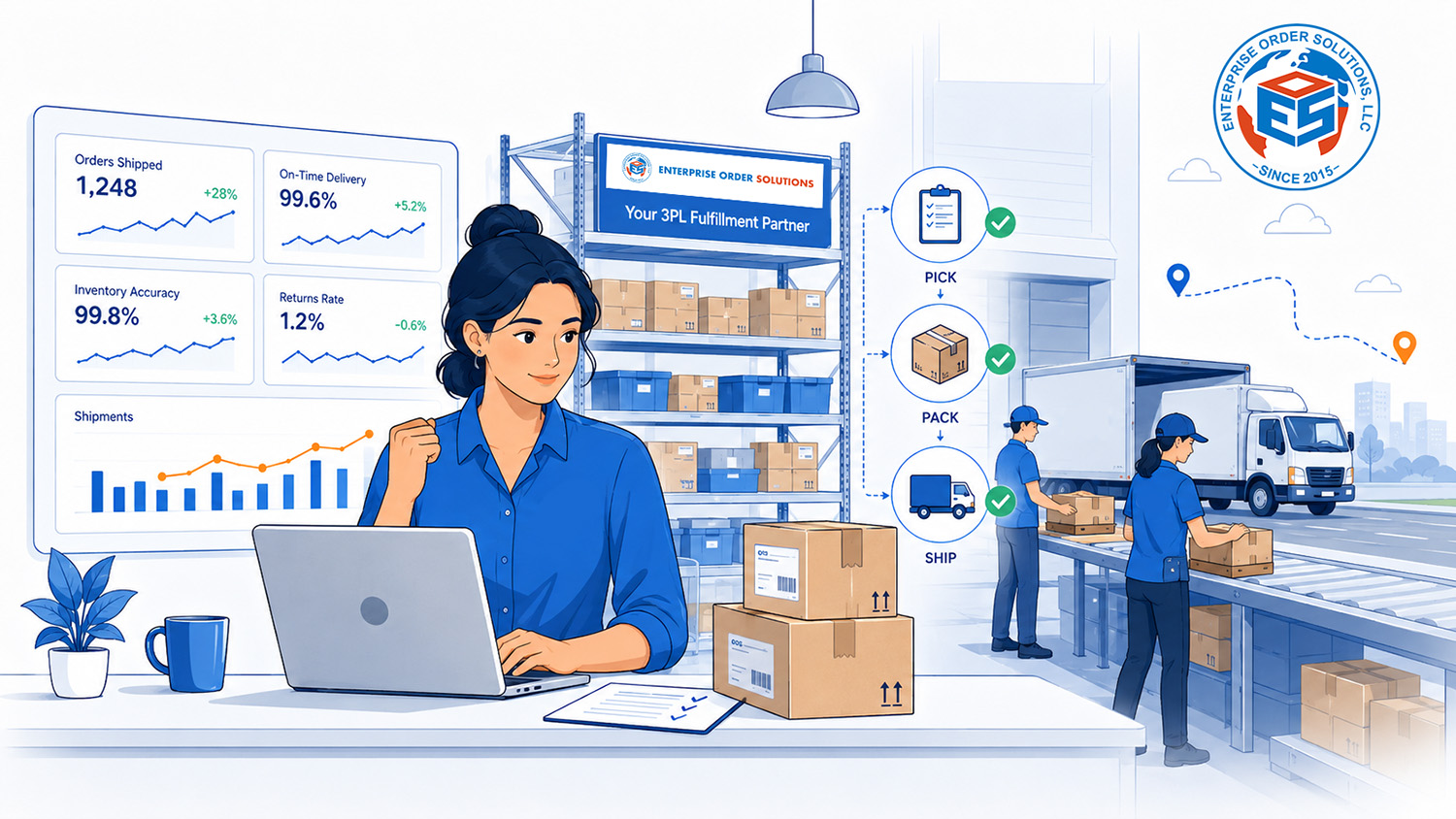
How a 3PL Fulfillment Partner Helps Ecommerce Brands Scale
A 3PL fulfillment partner helps growing ecommerce brands scale order fulfillment without carrying every warehouse, labor, system, and shipping burden alone. This guide explains how the right partner can improve control, inventory visibility, shipping execution, customer experience, and fulfillment capacity as your brand grows across multiple sales channels.
When a 3PL Fulfillment Partner Becomes the Smarter Growth Move
When fulfillment becomes a growth constraint, the next question is not simply how to ship more orders.
It is how to expand the operation behind those orders without turning growth into a warehouse expansion problem.
For many mid-size ecommerce brands, that question appears when leadership starts considering more warehouse space, regional inventory placement, faster shipping coverage, or a broader nationwide fulfillment network. The product is selling. Sales channels are producing. Customers are ordering. The current fulfillment model has carried the business this far.
But the next stage asks for more.
- More rent
- More labor
- More training
- More equipment
- More technology
- More shipping management
- More inventory liability
- More pressure when volume changes
Opening another warehouse can look like progress, especially when your brand is thinking about faster delivery or nationwide coverage. But every new location adds fixed cost, staffing needs, training, inventory control, technology requirements, carrier coordination, and another layer of operational responsibility.
That is not just logistics support. It is leadership attention, and leadership attention is expensive.
Your company still needs to study business trends, research customer behavior, develop better products, create new offers, strengthen listings, improve photography and video, advertise effectively, expand marketplace reach, and retain customers. Those are the activities that create future demand.
When fulfillment expansion becomes too heavy, the business can get pulled into a different kind of growth work: warehouse growth, labor growth, systems growth, freight management growth, and operational risk management.
Those things may be necessary, but they are not the reason your brand exists.
That is the real decision many mid-size ecommerce brands face:
Is expanding fulfillment internally still the best use of capital, leadership time, and operational risk?
At a certain point, the smarter move may not be building more fulfillment infrastructure alone. The smarter move may be partnering with a 3PL fulfillment provider that already has the operational foundation to support the next stage.
Many brands hesitate because choosing a 3PL can feel like giving up control. That concern is understandable. Inventory, shipping, customer experience, marketplace standing, and fulfillment execution are too important to hand over blindly.
The right 3PL fulfillment partner should not reduce your control. It should improve it.
A strong fulfillment partner gives your brand better visibility into inventory, orders, shipments, and fulfillment activity. You should be able to define expectations, set execution preferences, review performance, and make cleaner decisions based on accurate fulfillment data.
Fulfillment control is not about touching every package. It is knowing what is happening, why it is happening, and whether the process is protecting your customer promise.
The right partner helps move your brand from manual firefighting to a more dependable operating model. That means your leadership team can spend less time chasing order status, shipping issues, warehouse questions, and fulfillment updates, and more time focused on the work that actually grows the business.
That is where your company’s attention belongs.
A good 3PL fulfillment partner is not just a cheaper warehouse. It is a partner that helps your business scale cleanly, maintain stronger visibility, protect the customer experience, and stay focused on building the brand.
For ecommerce brands, survival is not only about getting orders out today. It is about building a fulfillment model that can support tomorrow’s demand.
Previous guide: Why Ecommerce Fulfillment Problems Get Worse Across Multiple Sales Channels
What a 3PL Fulfillment Partner Should Control Before Orders Ship
A stronger fulfillment model does not begin when the carrier picks up the package. It begins much earlier.
Before an ecommerce order can ship accurately, the product has to be received, counted, stored, organized, and made available for fulfillment. We covered that foundation in the EOS guide to Warehouse Storage & Distribution Services and the related EOS solution for Warehouse Receiving & Inventory Control.
Those stages matter because ecommerce fulfillment depends on them. As covered in our guide to how ecommerce fulfillment services work, the warehouse foundation becomes the operating base for every customer order.
If inventory is not received accurately, the order flow will eventually feel it. If storage locations are unclear, picking becomes slower. If counts are not trustworthy, sales channels can oversell. If products are not organized for movement, shipping speed becomes harder to protect.
By the time an order reaches the packing station, the issue may already be waiting inside the operation.
That is why a 3PL fulfillment partner should not only be judged by how fast boxes leave the building. The better question is:
Can the partner control the conditions that make accurate fulfillment possible in the first place?
That is the difference between a commodity warehouse and a strategic fulfillment partner.
A commodity warehouse reacts to orders. A strategic fulfillment partner helps control the operating flow behind those orders.
For ecommerce brands, this becomes especially important when fulfillment is not simple.
Some brands are not only shipping one small item in one small box. They may be selling furniture, home goods, appliances, oversized cartons, bundled products, promotional kits, multi-piece orders, or marketplace-specific product configurations. Some orders may require special packaging. Some may need channel-specific preparation. Some may need handling rules based on product size, delivery expectations, or customer experience requirements.
That kind of complexity does not mean your brand has to keep fulfillment in-house. It means the fulfillment process has to be understood, documented, and executed correctly.
This is where partner fit matters.
A parcel-only 3PL may be well suited for lightweight, uniform products. But larger products, bundled orders, and more complex ecommerce fulfillment workflows require a different level of warehouse control. Product size affects storage, picking, packing, labeling, carrier selection, damage risk, and delivery experience.
Your customer does not see those upstream details. They only see whether the order arrives correctly.
That is why the right 3PL fulfillment partner has to connect warehouse readiness to order execution. The work covered in earlier supply chain stages does not disappear when fulfillment begins. It becomes the foundation that supports every customer promise.
Moving product is only the baseline. The real value comes from controlling the fulfillment process well enough to protect accuracy, delivery expectations, and the customer promise.
When the upstream process is controlled, the downstream experience improves. Orders can be picked with more confidence, packing can follow the right requirements, shipping decisions can align with product type and customer expectations, and leadership can make decisions based on what is actually happening, not what everyone hopes is happening.
That is how a 3PL fulfillment partner creates operational confidence before the order ever leaves the warehouse.
Because fast shipping only works when the warehouse foundation is ready to support it.
How Fulfillment Systems Improve Inventory and Order Visibility
Once the warehouse foundation is in place, the next question is visibility.
A growing ecommerce brand cannot make clean business decisions if inventory, orders, shipments, and marketplace activity are scattered across disconnected systems. The operation may still be moving, but leadership needs clarity, not just movement.
That is where fulfillment systems matter.
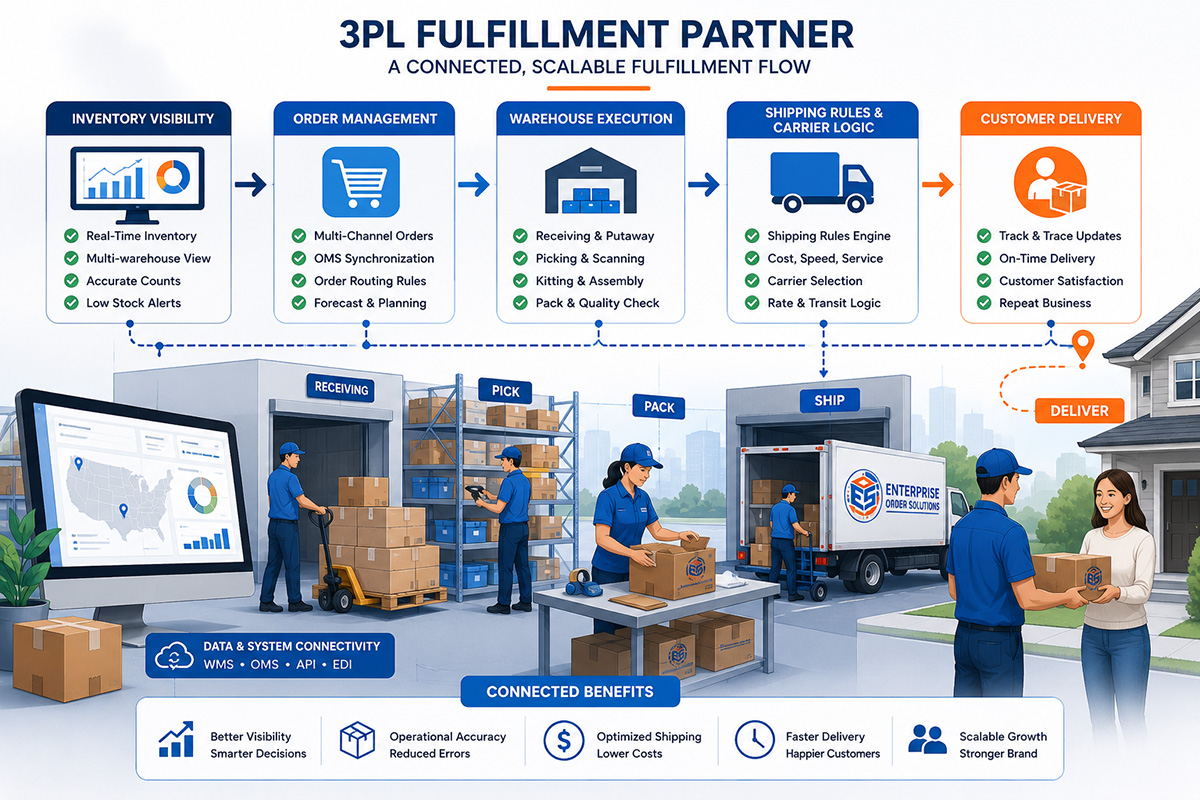
For ecommerce brands, visibility usually depends on how well the order management system, warehouse management system, and warehouse floor execution work together.
An OMS, or order management system, helps organize the flow of orders coming from different sales channels.
A WMS, or warehouse management system, helps manage inventory, locations, picking activity, fulfillment workflows, and warehouse execution.
A PDA scanner helps connect the system to the physical work on the floor by verifying inventory movement, picks, counts, and fulfillment activity as they happen.
When those systems work together, your brand gets a clearer operating picture.
- Inventory is easier to trust
- Orders are easier to track
- Shipments are easier to manage
- Marketplace channels are easier to support
- Customer service has better information
- Leadership can make decisions with more confidence
Visibility does not mean your team should have to babysit every shipment. That would only create a more expensive version of the same problem.
The goal is not to make your brand watch every order manually. The goal is to give your business control at the strategy, policy, and visibility level while the logistics partner executes the operational flow.
Your brand should be able to define how fulfillment should work without manually managing every shipment. That is where customizable rules matter.
You can set fulfillment rules based on sales channel, product type, shipping priority, carrier preference, service level, region, customer expectation, or marketplace requirement. Some orders may prioritize the lowest practical shipping cost. Others may require the fastest available service. Some may need the most reliable carrier for a specific region, product size, or delivery requirement. Others may require special handling, bundled preparation, kitting instructions, or marketplace-specific packaging.
Those rules help the fulfillment process scale.
Shipping decisions should also follow your fulfillment strategy.
EOS systems support transportation management logic that helps align shipping decisions with the client’s operational goals. Through system-supported rules and coordinated carrier workflows, clients can define priorities around cost, speed, carrier preference, service level, product type, region, or marketplace requirements. When an order is ready to move, the fulfillment execution model can help apply those rules so shipments follow the operational goal the client has defined.
For some orders, the priority may be the lowest practical shipping cost. For others, it may be the fastest delivery option or the most reliable carrier for a specific region, product size, or customer expectation. Clients may also manage specific orders when shipment-level control is needed.
For ecommerce brands, shipping is not only an expense. It is part of the customer promise.
Automation helps repeated decisions move cleanly, but automation should not remove control. That is the balance a strong 3PL relationship should create:
automated rules for scale, shipment-level control for precision, and logistics execution from the partner.
Then the logistics partner executes those requirements through the fulfillment stages.
- Inventory
- Order flow
- Picking
- Packing
- Shipping
- Tracking
That is the difference between losing control and gaining a better operating system.
Your brand keeps control of the fulfillment strategy. EOS helps execute the logistics flow behind it.
This is especially important for brands selling across multiple marketplaces.
When Amazon, Walmart, eBay, Wayfair, Home Depot, Lowes, Shopify, and other channels are all part of the sales mix, inventory control becomes more than a warehouse concern. It becomes a revenue, customer experience, and marketplace performance issue.
For brands selling across major ecommerce channels, system integration becomes part of the fulfillment strategy. EOS has explored this more deeply in guides on Shopify WMS integration, Amazon fulfillment WMS integration, and Walmart Marketplace WMS integration.
If the data is delayed, your business reacts late. If the data is wrong, your business makes poor decisions. If the data is scattered, your team spends too much time trying to understand what should already be clear.
A better fulfillment model should reduce that fog. The result is not less control. It is better control.
Your brand keeps control of the business direction, shipping priorities, service expectations, and customer promise. The logistics partner executes the flow that makes those decisions real inside the warehouse and across the shipping network.
That is where systems create value, not because technology looks impressive, but because accurate data and disciplined execution help your business make better decisions, fulfill customer promises, and scale with more confidence.
How 3PL Fulfillment Services Help Protect Customer and Marketplace Reputation
Once fulfillment is connected to better systems, clearer rules, and stronger execution, the next benefit becomes easier to see.
Your brand is not just protecting warehouse efficiency. It is protecting the promise made to the customer.
That promise may start on a product page, a marketplace listing, an ad, or a brand website. The customer sees the photos, reads the reviews, compares the price, checks the delivery expectation, and decides to buy.
After checkout, that promise moves into fulfillment.
- The right product has to be picked
- The order has to be prepared correctly
- The packaging has to match the product
- The shipping method has to support the customer expectation
- The tracking has to update clearly
- The delivery experience has to protect trust
That is where 3PL fulfillment services can support more than warehouse movement. A strong fulfillment partner helps your brand execute the operational details that customers and marketplaces quietly judge every day.
In ecommerce, reputation is not a soft metric.
Reputation affects customer confidence, repeat purchases, marketplace trust, review quality, seller standing, and long-term sales opportunity. A customer may discover your brand through Amazon, Walmart, eBay, Wayfair, Home Depot, Lowes, Shopify, social media, or paid advertising, but fulfillment shapes what they remember after the order is placed.
This is why fulfillment performance sits at the center of the broader Ecommerce Fulfillment & 3PL Services guide: once the customer places the order, fulfillment becomes the brand promise in motion.
Fast shipping matters, but reliable shipping matters more.
Customers do not only want speed. They want confidence. They want to know the order is moving, the tracking is real, the product will arrive correctly, and the brand will respond clearly if something needs attention.
For marketplace sellers, the stakes can be even higher.
Each sales channel has its own way of measuring customer experience and seller performance. The exact requirements may vary, but the standard is clear: sellers are expected to fulfill orders accurately, ship on time, update tracking, follow marketplace expectations, and avoid preventable service issues.
That means fulfillment quality can influence more than one transaction. It can influence seller reputation, customer reviews, repeat purchases, account health, marketplace confidence, and future sales visibility.
As covered in the previous guide on ecommerce fulfillment problems across multiple sales channels, repeated shipping delays, unclear tracking, and poor preparation can turn fulfillment pressure into customer experience and marketplace performance risk.
For brands working to maintain strong marketplace standing, or preserve advantages such as Top Rated Seller status where applicable, fulfillment execution becomes part of the growth strategy. Late shipments, canceled orders, unclear tracking, damaged deliveries, and poor preparation can weaken the trust your brand has worked hard to build.
This is especially important for ecommerce brands with larger products, bundled orders, furniture, home goods, appliances, or oversized shipments. When the product is larger, heavier, more expensive to ship, or harder to replace, the delivery experience carries more weight.
A small item arriving late may frustrate the customer. A large item arriving late, damaged, incomplete, or poorly coordinated can create a much bigger problem.
That is why the fulfillment process has to match the customer promise.
Orders should not be treated as random warehouse tasks. They are part of the brand experience.
- The right item has to be picked
- The right preparation has to be followed
- The right packaging has to be used
- The right shipping method has to be applied
- The tracking has to update
- The customer experience has to feel dependable
When those steps are executed consistently, the customer experience becomes more reliable.
That reliability can become a competitive advantage.
A brand with dependable fulfillment can support cleaner delivery expectations, stronger review outcomes, better marketplace performance, and a more professional buying experience. Over time, that helps the brand extend its reach because customers and marketplaces both respond to consistency.
This is where the partnership matters.
A commodity warehouse asks:
“How many orders do you ship?”
A strategic fulfillment partner asks:
“What kind of customer experience are you trying to protect?”
That question changes the conversation.
Fulfillment is not only about shipping cost, warehouse space, or order volume. It is about making sure the logistics operation supports the brand promise in the real world.
When fulfillment works, customers feel it. When fulfillment breaks, customers feel that too.
The difference is whether your brand has a logistics partner disciplined enough to help protect the reputation it has already earned.
How EOS Supports Scalable Ecommerce Fulfillment
At this stage, the better question is whether your fulfillment operation is strong enough to support the brand you are building.
Your business has already earned momentum. Orders are moving. Inventory is active. Sales channels are producing. Customers are buying. The opportunity is real.
But if fulfillment is consuming too much time, attention, cost, and operational risk, growth can start to feel heavier than it should.
That is where Enterprise Order Solutions fits into the story.
EOS helps ecommerce brands move from fulfillment pressure into a more controlled logistics flow. The goal is not simply to take warehouse work off your plate. The goal is to help your business fulfill customer promises more consistently while giving your team more room to focus on growth.
Your company should not have to choose between growing the brand and protecting the operation. You need both.
A good 3PL fulfillment partner helps your business keep moving without forcing you to carry every warehouse, labor, system, and shipping burden alone. Instead of expanding internal fulfillment capacity at every growth stage, you can align with a logistics partner that already has the infrastructure, systems, and execution discipline to support order flow.
That gives your team a better operating lane.
You can store inventory based on actual business needs instead of locking into too much fixed warehouse space. You can support changing order volume without constantly rebuilding labor capacity. You can gain better visibility into inventory, orders, shipments, and fulfillment performance. You can apply shipping and handling rules that reflect your customer promise, product type, marketplace requirements, and delivery expectations.
With EOS, your brand is not forced into a one-size-fits-all fulfillment process. You can define how the operation should run through shipping preferences, fulfillment rules, product handling requirements, channel expectations, and shipment-level decisions when needed.
EOS helps execute those requirements across the logistics flow.
That means you keep control of the business direction and fulfillment priorities, while EOS manages the operational execution that turns those decisions into shipped orders.
This is what makes the relationship scalable.
You do not have to manually chase every shipment to stay in control. You can use automated rules where the process should repeat, and still step in on individual shipments when precision matters.
That is the benefit of the right partnership.
EOS is not built for brands looking for the lowest warehouse quote. EOS is a better fit for ecommerce operators that need disciplined fulfillment execution, inventory control, shipping visibility, marketplace support, and a partner capable of supporting growth.
For some brands, the value is flexible warehouse capacity instead of overcommitting to fixed internal space.
For others, it is reducing the cost and risk of opening additional warehouse locations before the business is ready to carry that overhead.
For others, it is avoiding workforce imbalance: too many people during slower periods, not enough labor during demand spikes, and too much management time spent trying to balance the two.
For others, it is shipping coordination and rate leverage. By aligning with a fulfillment partner that moves higher shipping volume across customers, your brand may gain access to shipping advantages that are harder to achieve alone.
Shipping coordination also connects to the broader EOS Transportation & Distribution workflow, where carrier coordination, delivery expectations, and regional movement can affect fulfillment performance.
For others, it is synced inventory, cleaner order visibility, and better data across marketplace and DTC channels.
Often, the value is all of those working together.
That is where the financial case becomes easier to recognize.
A 3PL fulfillment partnership can help your business expand capacity without forcing you to build every piece of the fulfillment network yourself. You can spend based on what the operation actually needs, scale as volume changes, and avoid overpaying for warehouse space, labor, and systems that may not stay aligned with demand.
EOS can support ecommerce fulfillment across DTC websites, marketplace channels, and broader order execution needs. That includes brands selling through Amazon, Walmart, eBay, Wayfair, Home Depot, Lowes, Shopify, and other channels where inventory accuracy, shipping speed, tracking updates, and customer experience all matter.
But the right partnership is not only about channel count. It is about operational fit.
That is especially important for brands with larger products, heavier cartons, furniture, appliances, home goods, oversized shipments, bundled items, promotional kits, or fulfillment profiles where handling, packaging, carrier selection, and shipping decisions matter more than a simple small-parcel workflow.
Some brands assume their fulfillment operation may be too customized for a 3PL because orders require more than basic pick, pack, and ship. That concern is understandable.
Your fulfillment workflow may include kitting, bundling, special packaging, marketplace-specific preparation, product handling rules, or shipment logic that changes by channel, product type, region, or customer expectation.
Those requirements do not mean you have to keep every fulfillment function in-house.
They mean your fulfillment workflow has to be understood, documented, and executed through a proven solution workflow.
That is why the EOS approach starts with learning the operation before recommending the plan.
- What products are being stored?
- Which sales channels are active?
- How does order volume change?
- What shipping expectations do customers have?
- What marketplace requirements need to be protected?
- What packaging or kitting requirements matter?
- What product handling rules affect the customer experience?
- Where does the current fulfillment model slow the business down?
Those questions matter because a strong 3PL relationship should not feel like handing your business over to a warehouse. It should feel like gaining a logistics partner that understands the business well enough to execute the right plan.
When the partnership works, the value becomes clear.
- Your business gains fulfillment capacity without overbuilding
- Your team avoids carrying unnecessary warehouse and labor overhead
- Your inventory can scale with demand
- Your shipping strategy can benefit from EOS volume and coordination
- Your customers receive a better buying experience
- Your marketplace channels receive stronger execution
- Your leadership team gets clearer information
- Your business gains more room to grow
That is the partnership path.
You keep building the brand.
EOS helps execute the fulfillment system behind it.
The cheapest warehouse may reduce today’s quote. The right 3PL fulfillment partner helps protect tomorrow’s growth.
For ecommerce brands ready to scale fulfillment without carrying every warehouse, labor, system, and shipping burden alone, EOS can help create a cleaner path from inventory to customer delivery.
Related EOS Solution: Explore EOS Fulfillment & Order Execution
Frequently Asked Questions About 3PL Fulfillment Partners
What does a 3PL fulfillment partner do for ecommerce brands?
A 3PL fulfillment partner helps ecommerce brands manage the operational work behind customer orders. This can include warehouse receiving, inventory storage, order processing, pick-and-pack fulfillment, shipping coordination, tracking updates, marketplace fulfillment support, and fulfillment data visibility.When should an ecommerce brand consider using a 3PL fulfillment partner?
An ecommerce brand should consider using a 3PL fulfillment partner when internal fulfillment expansion becomes too costly, risky, or distracting to manage alone. This often happens when a brand needs more warehouse space, regional inventory placement, faster shipping coverage, more labor, stronger systems, or a broader fulfillment network.Does using a 3PL fulfillment partner mean losing control of fulfillment?
No. The right 3PL fulfillment partner should not reduce your control. It should improve it. A strong 3PL relationship gives the brand visibility into inventory, orders, shipments, fulfillment performance, and shipping activity while allowing the brand to define fulfillment rules, shipping preferences, service expectations, and product handling requirements.How do OMS, WMS, PDA scanning, and TMS support ecommerce fulfillment?
Fulfillment systems help connect online order activity to warehouse execution and shipping decisions. An OMS organizes orders from sales channels, a WMS manages inventory and warehouse workflows, PDA scanning verifies physical warehouse activity, and transportation management logic supports smarter carrier and shipping decisions.Can a 3PL fulfillment partner support kitting, bundling, oversized products, and marketplace preparation?
Yes, the right 3PL fulfillment partner can support more than basic pick, pack, and ship workflows. Many ecommerce brands require kitting, bundling, special packaging, promotional fulfillment, marketplace-specific preparation, product handling rules, multi-piece orders, or shipment logic that changes by channel, product type, region, or customer expectation.How can a 3PL fulfillment partner help reduce fulfillment costs?
A 3PL fulfillment partner can help reduce fulfillment costs by giving ecommerce brands access to scalable warehouse capacity, fulfillment labor, shipping coordination, and systems without requiring the brand to build every part of the network internally. A 3PL may also provide shipping advantages through higher shipment volume, carrier coordination, and transportation management tools.What makes EOS a strong 3PL fulfillment partner for growing ecommerce brands?
EOS supports brands that need disciplined fulfillment execution, inventory control, shipping visibility, marketplace support, flexible warehouse capacity, and a logistics partner capable of supporting growth. EOS is especially valuable for brands with larger products, heavier cartons, home goods, furniture, appliances, oversized shipments, bundled items, promotional kits, or fulfillment workflows where handling, packaging, carrier selection, and shipping decisions matter.Continue Exploring Ecommerce Fulfillment & 3PL Services
This article completes the current ecommerce fulfillment guide series. Return to the pillar guide, explore all logistics guides, or review the EOS fulfillment solution page.
Discover more from Enterprise Order Solutions
Subscribe to get the latest posts sent to your email.