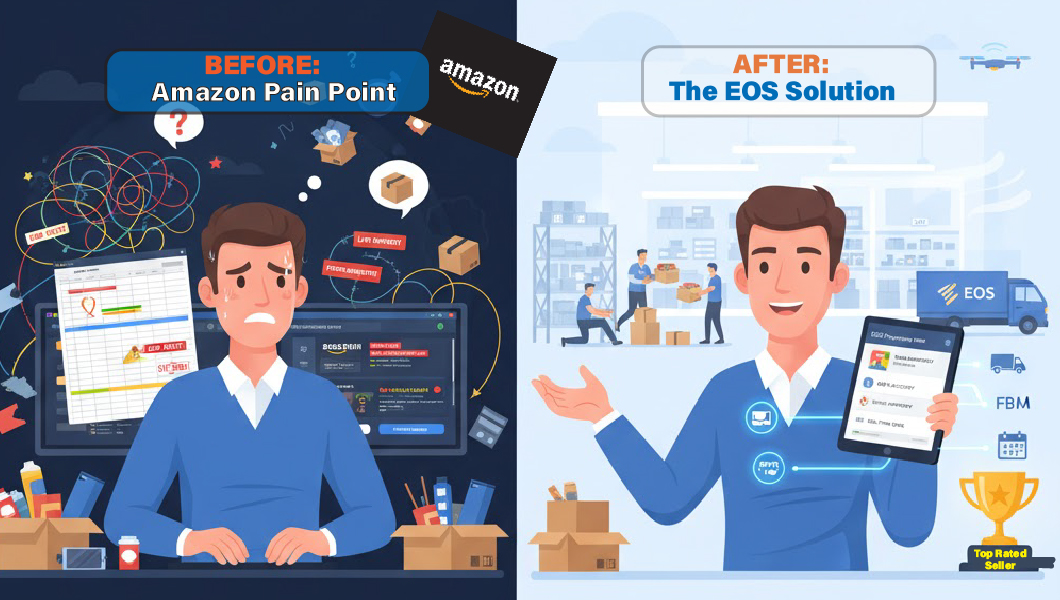
Amazon gives brands incredible sales volume—but it also forces sellers into a constant logistical tug-of-war. You get reach, but you lose control. You gain velocity, but you inherit risk.
That tension drains margin, creates operational stress, and turns every inventory decision into a high-stakes guess.
At Enterprise Order Solutions (EOS), we solve that problem by unifying FBA and FBM through technology. Oversells, unpredictable FBA fees, and compliance challenges become manageable when your fulfillment partner gives you back the operational control Amazon takes away.
The Power of WMS Integration: A Strategic Lifeline
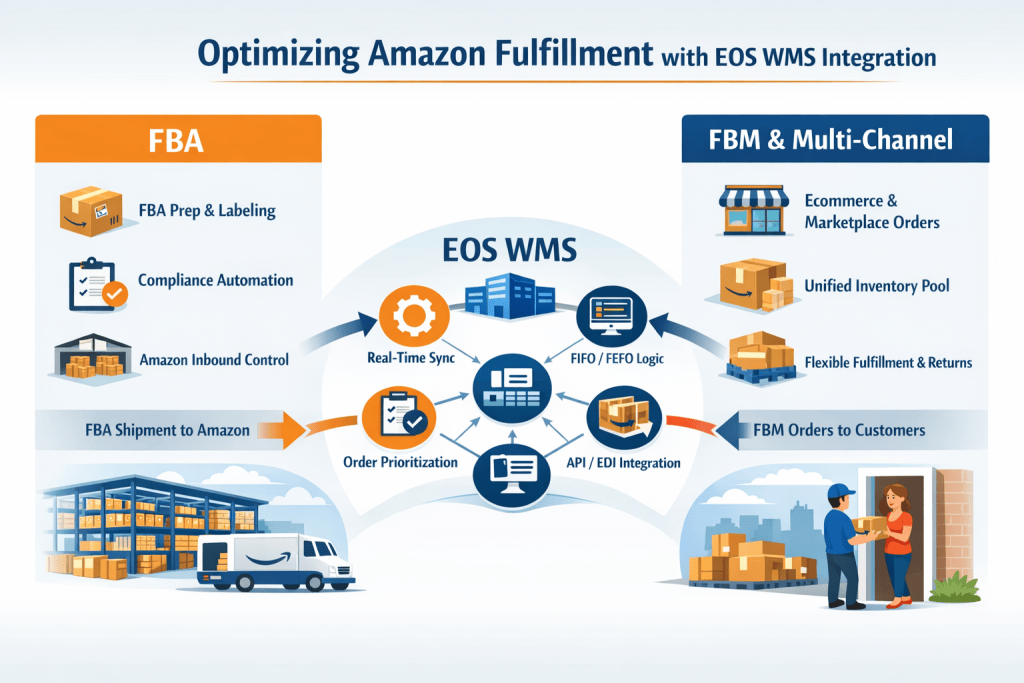
Amazon’s logistics operate behind a black-box system. EOS removes the guesswork. Our proprietary Warehouse Management System (WMS) connects your Amazon storefront to our warehouse floor with real-time accuracy.
How EOS WMS Integrates with Amazon Using advanced API and EDI connections as an Amazon Service Provider, our system maintains real-time data flow for FBM order processing and FBA inbound inventory management. We control the prep, labeling, routing, and timing of your FBA replenishment—while Amazon controls inventory once it arrives at their facilities.
The impact is immediate:
Real-Time Inventory Sync Your available inventory updates instantly for FBM and other sales channels, reducing oversells and stabilizing customer experience.
Automated Compliance Amazon’s labeling, packing, and routing requirements are translated directly into warehouse tasks. Every FBA shipment leaves our dock fully compliant, drastically reducing fees and chargebacks.
Order Prioritization You set the business rules; our WMS executes them. Whether it’s an urgent FBM order or critical FBA replenishment, priority is managed automatically, or by your manual control.
Why EOS Outperforms Pure FBA
Relying solely on FBA gives you speed but limits your control—especially with sensitive, high-risk, or fast-moving inventory. EOS gives growing brands a more strategic, scalable operation.
Fragmentation & Waste EOS maintains a unified inventory pool inside our warehouse for FBM, multi-channel fulfillment, and FBA replenishment. One location. One source of truth. This eliminates double-stocking and optimizes working capital.
FIFO & Expiration Risk Our WMS enforces FIFO (or FEFO for perishable goods) on every pick. This protects product integrity and prevents outdated inventory from reaching customers.
Inventory Black Box → Total Visibility Inside our facilities, every unit is trackable by location, age, and status. You get real-time clarity over your operational data.
Long-Term Storage Fees Our FBA Transit workflows help you control exactly when and how much inventory enters Amazon’s network. This avoids long-term storage fees and increases sell-through efficiency.
Breaking Down the EOS Advantage
1. Proprietary WMS = Better Compliance and Control A custom WMS enables automated workflows, higher accuracy, and inventory rules tailored to your brand.
2. FIFO/FEFO Logic to Protect Quality Every pick follows strict aging rules, reducing expired or outdated stock issues. The result is customers get products within their product life date, ensuring their satisfaction and repeat business.
3. Unified Inventory for FBM, FBA Prep, and Multi-Channel Fulfillment All channels draw from one physical inventory pool in our warehouse—simplifying planning and reducing oversells. Very efficient when your company may be selling on multiple marketplaces.
4. Real-Time Sync Across Sales Channels API/EDI integration keeps your storefront accurate and prevents stockouts.
5. Fully Compliant FBA Shipments Our FBA prep process automates labeling, carton content, and routing to minimize Amazon chargebacks.
6. More Control Than FBA Alone EOS supports kitting, specialized handling, packaging needs, and custom returns—flexibility FBA cannot offer.
🗨️ Community Question
Amazon operations evolve quickly, and every brand feels different pressure points. What trends or challenges are you seeing in your Amazon logistics that others in the community should be paying attention to next?
Have you had any recent experiences in the following scenarios?
Scenario A: Have you ever had a customer receive an expired or outdated product because Amazon didn’t ship stock in FIFO order? Yes or no?
Scenario B: You send extra inventory to FBA to stay ahead, and long-term storage fees hit harder than expected. Seeing this or not really?
Related
Discover more from Enterprise Order Solutions
Subscribe to get the latest posts sent to your email.