Why Inventory Storage Breaks Down Before Distribution Begins
Growth can expose warehouse storage problems that were easy to manage at lower volume. This guide explains why inventory storage breaks down before distribution begins, how seasonal pressure reveals hidden weakness, and why workarounds eventually create operational strain.
Why Growing Businesses Outgrow Their Inventory Storage Plan
Growth usually feels like proof that the business is working.
Orders increase. Customers return. New channels open. Seasonal demand gets stronger. Product lines expand. What once felt like a small operation starts becoming a real distribution engine.
At first, the original logistics plan may still seem good enough. The same warehouse process, the same team, the same spreadsheet, the same storage layout, or the same daily routine may continue holding everything together. For a while, extra effort can cover the gaps.
Then the pressure starts to change.
More inventory needs to be received, stored, counted, staged, and moved. More orders depend on accurate availability. More teams need reliable answers. More customers expect faster movement. The warehouse is no longer just a place where product sits. It becomes the point where business growth either keeps moving or starts getting stuck.
That is where many growing companies first feel the warning signs.
A setup that worked when volume was lower can become harder to trust when the business gets larger. Inventory that used to be easy to locate now takes more time to confirm. Storage areas that once felt organized start feeling crowded or inconsistent. Replenishment requests create more follow-up. Outbound movement becomes less predictable than it should be.
The system did not fail overnight. The business outgrew it.
Many warehouse problems begin when a company grows beyond the process that originally made sense.
We understand how frustrating that can be because this is not usually caused by careless planning. In many cases, the original plan made sense at the time. It matched the size of the business, the order volume, the available labor, and the level of complexity the company was managing.
But logistics does not stay simple when the business grows.
Every new SKU, customer, sales channel, promotion, and seasonal peak adds another layer of pressure. If the warehouse process does not scale with that growth, the operation slowly becomes more reactive. Teams start solving the same problems again and again, not because they are doing bad work, but because the system underneath them is no longer strong enough to carry the load.
That is when inventory storage begins to break down before distribution even starts.
Why Inventory Storage Breaks Down Before Distribution Begins
Inventory storage usually does not break down all at once.
It begins with small gaps that are easy to explain away. A pallet is placed where there was room, not where it truly belongs. A count is close enough for the moment, but not confident enough for planning. A product is received, but not staged in a way that supports the next move. A storage area looks full, but not fully controlled.
At first, these problems may not seem urgent.
The team can still find the product. Orders can still move. Replenishment can still happen. But as volume increases, each small workaround starts adding time, uncertainty, and pressure to the operation.
That is where stored inventory starts becoming harder to trust.
Product may be physically in the warehouse, but the operation still has to confirm where it is, how much is available, whether it is accessible, and whether it is ready for outbound movement. When those answers are not clear, the warehouse begins slowing decisions instead of supporting them.
This is one of the most common signs that storage has outgrown its original structure.
The issue is not only space. It is placement, visibility, count accuracy, staging discipline, and readiness. A warehouse can have product on the floor, racks, or pallets and still struggle because the inventory is not organized around what the business needs next.
Inventory can be stored and still not be ready.
Distribution readiness depends on more than product being physically inside the building.
As we explained in How Warehouse Storage and Distribution Services Actually Work, stored inventory and distribution-ready inventory are not always the same thing.
That gap becomes more expensive as the business grows. Operations teams begin spending more time checking than moving. Customer service waits for confirmation. Sales becomes less confident in availability. Leadership sees inventory on paper but feels hesitation in execution.
We have seen this pattern many times before. Storage problems rarely begin as obvious failures. They begin as small mismatches between where inventory is, how it is tracked, and what the business needs it to do next.
Once those mismatches begin to repeat, distribution readiness starts weakening before the first outbound step even begins.
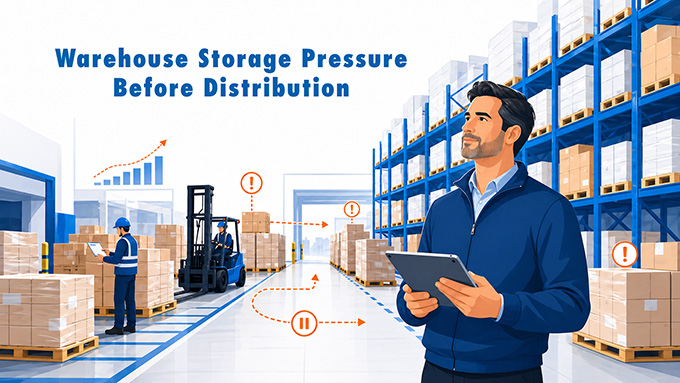
How Seasonal Peaks Expose Warehouse Storage Problems
Normal volume can hide warehouse problems. Peak season reveals them.
During slower periods, a team may be able to work around storage issues with extra effort. Someone checks a location twice. Someone asks the warehouse team for confirmation. Someone walks the floor to find a pallet that should have been easier to locate. The process is not ideal, but the business keeps moving.
Then demand spikes.
Seasonal peaks, product launches, wholesale replenishment cycles, retail promotions, and sudden channel growth all increase pressure at the same time. More inventory needs to move. More customers are waiting. More teams need answers. More outbound activity depends on whether stored product is actually ready for the next step.
That is when hidden storage problems become much harder to ignore.
A storage layout that felt acceptable during normal volume may not support faster movement. Counts that were close enough during slower periods may no longer be good enough when orders and replenishment requests increase. Staging areas that were manageable before may start creating congestion. Small delays that once felt harmless begin stacking into larger operational drag.
This is also where upstream handoffs can start showing their downstream effects. Freight may arrive successfully, but if inventory is not stored, staged, and prepared correctly after that handoff, the next phase can still slow down. That same pattern appears in transload and crossdock operations, where freight can arrive successfully and still create friction before the next stage begins.
For a growing business, this is a dangerous moment because the pressure arrives when the company most needs confidence. The promotion worked. The season is active. The demand is real. But instead of feeling ready, the warehouse begins requiring more checking, more coordination, and more recovery work.
The business is growing, but the operation feels less certain.
That is how seasonal pressure exposes the difference between a warehouse that can hold inventory and a warehouse process that can actually support distribution readiness.
How Warehouse Workarounds Create Operational Strain
Once inventory storage starts breaking down, the team usually does not stop the operation. They compensate.
Someone checks the system, then checks the floor. Someone sends a message to confirm a count. Someone asks whether a pallet has been moved. Someone delays an outbound request until the product can be verified. One small workaround becomes part of the routine, then another, then another.
At first, that extra effort may feel responsible. The team is trying to protect the customer, avoid mistakes, and keep the business moving.
But over time, workarounds become warning signs.
When the warehouse requires extra effort just to stay accurate, the operation is already sending a message. The business is no longer running on a clean process. It is running on people constantly correcting, confirming, and protecting the process from breaking.
That pressure spreads quickly.
Operations teams lose time chasing answers. Customer service waits for updates before giving customers a clear response. Sales becomes cautious about promising availability. Leadership sees inventory in the system, but the team still hesitates before acting on it.
This is where fulfillment issues for importers often begin to feel bigger than one missed order or one delayed shipment. The problem is not only that product is difficult to move. The problem is that confidence starts weakening across the business.
The more the team works around the warehouse, the less the warehouse feels like a reliable operating system.
That creates a dangerous pattern. The business may still be moving, but it is moving with more friction than before. Every answer takes longer. Every exception pulls attention away from normal work. Every delay creates another conversation, another adjustment, another manual recovery step.
Over time, this becomes expensive in ways that are not always easy to see on a report.
The cost shows up in labor hours, missed opportunities, slower response times, delayed replenishment, weaker customer confidence, and leadership spending too much attention on problems the warehouse should have helped prevent. The team may still be keeping the business alive, but the effort required to do so keeps increasing.
And once that happens, growth becomes harder to support. More volume creates more checking. More demand creates more hesitation. More customer expectations create more pressure on a process that is already stretched.
That is when the old way of solving problems stops working.
The team may be working harder than ever, but the operation is no longer getting stronger. It is just absorbing more strain.
Why Distribution Readiness Becomes the Breaking Point
At a certain point, the question is no longer whether the business has inventory.
The question is whether that inventory can support the next move with confidence.
That is where warehouse storage breakdowns become more than an internal problem. If product is stored but difficult to verify, hard to access, or not staged for outbound movement, distribution readiness starts to weaken before the truck is ever loaded or the next order is released.
The business may still look strong from the outside. Orders are coming in. Customers are interested. Demand is moving. But inside the operation, the team is spending more time confirming inventory, adjusting plans, and recovering from storage friction that should not be slowing the business down.
That is the moment many growing companies begin to see the larger risk.
If storage stays disconnected from distribution planning, inventory will keep sitting longer than it should. If the warehouse stays reactive, the rest of the operation will start reacting too. Over time, that pressure can affect fulfillment timing, customer confidence, and the company’s ability to keep growing without adding more strain.
Predictable fulfillment depends on cleaner inventory readiness. When readiness breaks down, the business does not just lose time. It loses confidence in the system that is supposed to support growth.
That is the cliff edge.
The company has demand. The inventory exists. The team is working hard. But the operation is no longer strong enough to make the next move feel simple.
This is where warehouse friction becomes a real threat to growth. Not because the business stopped winning customers, but because the operation is no longer keeping up with the promise the business is making to those customers.
If the problem continues, the effects become harder to contain. Customer service carries more pressure. Sales loses confidence. Operations becomes reactive. Leadership starts questioning whether growth is creating progress or just creating more exposure.
That is how a storage problem becomes a distribution problem. Then a customer problem. Then a growth problem.
The problem has moved from the back of the warehouse into the center of the business.
This is where the story has to turn.
In the next article, How EOS Turns Stored Inventory into Distribution-Ready Execution, we look at what it takes to move from reactive warehouse storage into a more controlled operating model, where inventory is not only stored, but ready to support the business when it matters most.
Frequently Asked Questions About Inventory Storage and Distribution Readiness
What causes inventory storage to break down before distribution begins?
Inventory storage often breaks down when a business grows beyond the warehouse process that originally worked. More SKUs, more orders, seasonal peaks, and higher customer expectations can expose gaps in storage layout, count accuracy, staging, and inventory readiness.Why does warehouse storage become harder as a business grows?
Warehouse storage becomes harder as a business grows because inventory complexity increases. Products may need to move faster, be staged more carefully, and support more outbound demand. A process that worked at lower volume may start creating delays, extra checking, and uncertainty as the operation scales.How do seasonal peaks expose warehouse storage problems?
Seasonal peaks increase pressure on inventory movement, labor, staging areas, and outbound readiness. During normal volume, small storage issues may be hidden by extra effort. During peak periods, those same issues can create delays, congestion, count uncertainty, and weaker distribution performance.What are signs that inventory is stored but not distribution-ready?
Common signs include frequent count checks, hard-to-locate pallets, unclear product availability, inconsistent staging, delayed replenishment, and teams hesitating before releasing inventory for the next move. These are signs that product may be physically stored but not fully ready to support distribution.When should a business consider a 3PL warehouse partner?
A business should consider a 3PL warehouse partner when growth, seasonal demand, inventory complexity, or distribution pressure begin overwhelming the current operation. If teams are spending more time confirming, correcting, and recovering than moving inventory forward, the business may need a stronger warehouse operating model.What should a business review before choosing a warehouse storage partner?
A business should review whether the warehouse partner can support receiving, storage, inventory visibility, staging, outbound movement, and seasonal volume changes. The right partner should provide more than space; they should help inventory stay organized, accessible, and ready for the next step.How can EOS help with warehouse storage and distribution readiness?
Enterprise Order Solutions supports warehouse receiving, inventory control, storage, staging, fulfillment preparation, and distribution readiness. EOS helps businesses evaluate where warehouse friction is slowing operations and where stronger warehouse execution can support cleaner movement.Where can a business get help with warehouse receiving and inventory control?
Businesses can learn more through the EOS Warehouse Receiving & Inventory Control solution page, which explains how receiving discipline, inventory verification, and warehouse organization support stronger downstream execution.How EOS Turns Stored Inventory into Distribution-Ready Execution
Article 2 explains why inventory storage breaks down. The next guide will show how a stronger warehouse operating model helps turn stored inventory back into ready, controlled execution.
Related EOS Solution
Warehouse storage and distribution readiness depend on what happens after product enters the building. See how EOS supports receiving control, inventory verification, warehouse organization, and cleaner readiness through stronger inventory execution.
Explore Warehouse Receiving & Inventory ControlDiscover more from Enterprise Order Solutions
Subscribe to get the latest posts sent to your email.