
How EOS Turns Stored Inventory into Distribution-Ready Execution
A growing business does not just need inventory inside the warehouse. It needs inventory that is visible, organized, verified, staged, and ready to support the next move. This guide explains how EOS helps turn warehouse storage into scalable execution for businesses ready to grow with more control.
Why More Warehouse Storage Is Not Always the Solution
When warehouse operations start feeling strained, the first instinct is often simple:
Get more space.
More racks. More floor positions. More room to breathe.
And sometimes, more space really does help. A growing business may need additional warehouse capacity, especially when inventory volume increases, seasonal peaks hit harder, or new product lines expand faster than expected.
But space alone does not solve a readiness problem.
If inventory is hard to verify, more space just gives the confusion more room to spread. If pallets are staged without a clear next step, more floor space can become a larger waiting area. If teams are still checking, rechecking, and walking the floor to find answers, expanding the footprint does not automatically create control.
It only makes the operation bigger.
Do you need more warehouse space, or a warehouse operation that can support what comes next?
More capacity may reduce pressure temporarily, but better control changes the way the operation works.
As we covered in Why Inventory Storage Breaks Down Before Distribution Begins, many storage problems begin when the business outgrows the system that once worked. The original plan may have been perfectly reasonable at lower volume. But as orders increase, SKUs multiply, channels expand, and seasonal pressure builds, the warehouse has to do more than hold inventory.
It has to help the business move.
That is where the difference between storage and execution becomes clear.
Storage answers one question: Where can we put this product?
Warehouse execution answers a better question: How do we keep this product visible, organized, accessible, and ready for the next move?
That shift matters because growth does not wait for the warehouse to catch up. Customers still expect answers. Sales still needs confidence. Operations still has to move inventory. Leadership still needs the business to scale without every new order adding another layer of friction.
More space may reduce pressure temporarily, but better control changes the way the operation works.
For the operations leader who refuses to accept “good enough,” this is the turning point. The goal is not to build a larger place for problems to hide. The goal is to build a warehouse model where inventory can be received, stored, verified, staged, and released with more confidence.
Because a growing business does not just need inventory in the building.
It needs inventory ready for what comes next.
What Distribution-Ready Inventory Looks Like in a Warehouse
Distribution-ready inventory feels different the moment you walk the floor.
There is less searching. Less guessing. Less “let me check and get back to you.” Product has a place. Counts are easier to trust. Staging areas have a purpose. Movement feels intentional instead of improvised.
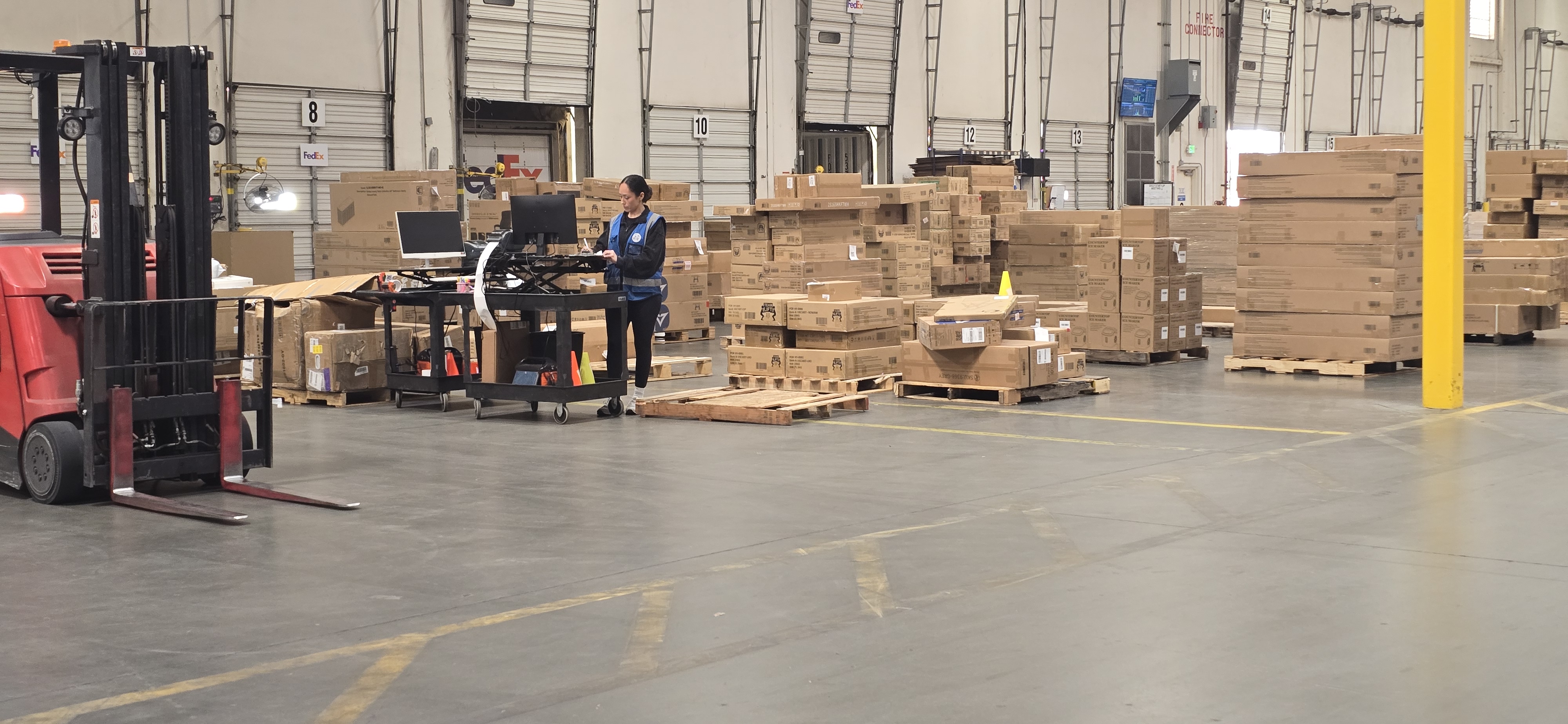
That does not mean the warehouse is silent or slow. A strong warehouse is still active. Forklifts move. Teams communicate. Orders release. Pallets shift from receiving to storage to outbound preparation. But the activity feels coordinated because the warehouse is not fighting itself.
That is the difference.
A warehouse can be busy and still controlled.
As we explained in How Warehouse Storage and Distribution Services Actually Work, stored inventory and distribution-ready inventory are not the same thing. Product becomes more useful when it is visible, accessible, verified, and aligned with what needs to happen next.
Distribution-ready inventory usually has a few clear signs:
- Product has been received and placed with purpose
- Inventory records match what the warehouse team can actually find
- Locations support movement without constant searching
- Staging areas are organized around outbound needs
- Teams can act with confidence instead of waiting for repeated confirmation
This is where warehouse storage becomes more than a holding function. It becomes part of the operating system that helps the business move.
Imagine a warehouse where the team knows what is available, where it belongs, and what needs to happen next. Customer service is not waiting for a floor check before answering a basic inventory question. Sales is not hesitant to promise availability. Operations is not constantly pulled into manual recovery mode.
That is not magic.
It is structure.
The best warehouse operations do not eliminate every exception. Logistics will always have surprises. Freight arrives late. Demand spikes. Customers change direction. A good system does not pretend those things never happen.
It simply gives the team a better way to respond.
When inventory is distribution-ready, the warehouse stops acting like a storage maze and starts acting like a launch point. Product is not just sitting in the building. It is positioned to support the next move, whether that means replenishment, fulfillment, wholesale distribution, transfer, or outbound freight.
That is the outcome a growing business should be working toward.
Not just more storage.
More usable inventory.
Why Strong Warehouse Execution Requires a Better System
A warehouse does not become distribution-ready because everyone tries harder.
Effort matters. Good people matter. Experienced warehouse leaders matter. But when volume increases and complexity grows, effort alone cannot carry the operation forever. At some point, the warehouse needs a system that helps good people execute consistently.
That system starts before inventory ever reaches a storage location.
Receiving has to be disciplined. Product needs to be checked, recorded, and directed into the warehouse with a clear plan. Putaway cannot be random. Location control has to make sense. Counts need to be reliable enough for the business to act on them. Staging areas need rules. Outbound preparation needs timing, visibility, and accountability.
Without that structure, the warehouse slowly becomes dependent on memory, habit, and heroic recovery.
That may work for a while, especially when the team knows the product well and volume stays manageable. But as the business grows, the same shortcuts become harder to defend. A process that depends on “ask Maria, she knows where it is” eventually becomes a bottleneck. Maria may be great, but Maria should not have to be the warehouse management system.
A warehouse should not depend on daily heroics to stay accurate.
Strong warehouse execution gives good people a repeatable system instead of asking them to rescue the process every day.
Strong warehouse execution requires the right combination of people, process, and visibility. The people keep the operation moving. The process gives them a repeatable way to work. Visibility gives leadership confidence that the operation is not being held together by guesswork.
That is where a stronger warehouse model begins to separate itself from basic storage.
Basic storage holds product.
A stronger warehouse execution model supports:
- Receiving and inventory verification
- Putaway and location control
- Cycle count support
- Storage organization
- Staging discipline
- Fulfillment preparation
- Outbound coordination
- Exception handling
- System-driven inventory visibility
The point is not to make the operation complicated. The point is to make the right work easier to repeat.
That is the simple power of good warehouse execution. The outside result looks simple: inventory is received, stored, found, staged, and moved. But behind that simplicity is structure. Every step supports the next one, so the team does not have to keep rebuilding the process every day.
For growing businesses, that structure becomes the difference between scaling with confidence and scaling with stress.
When warehouse execution is built around a system, the operations manager is no longer forced to spend every day chasing the same problems. They can start leading the operation forward, improving flow, preparing for demand, and supporting growth with more control.
That is the real shift.
From firefighter to strategic operations leader.
When a 3PL Warehouse Partner Becomes the Right Move
Not every growing business needs a 3PL partner right away.
Some teams only need a better layout. Some need temporary overflow space. Some need stronger internal inventory discipline. Some need better software, clearer roles, or a more consistent cycle count process.
That is why the right question is not, “Should we outsource the warehouse?”
The better question is:
What does the business need the warehouse to support next?
If the current operation can still support growth with a few internal improvements, that may be the right path for now. But when the same problems keep returning, when every busy season feels like a rescue mission, and when the team spends more time confirming inventory than moving it forward, the business may be entering a different stage.
That is often when a 3PL partnership becomes worth exploring.
A 3PL is not just a place to send inventory because the warehouse is full. At its best, a 3PL becomes an execution partner that helps the business absorb complexity, manage seasonal pressure, improve inventory control, and support distribution without forcing the company to build every piece of infrastructure internally.
For companies experiencing growth, the signs usually become clear:
- The team spends too much time checking and correcting inventory
- Seasonal peaks create more pressure than the internal operation can absorb
- Warehouse workarounds have become part of the daily routine
- Inventory confidence is weakening across sales, customer service, and operations
- Distribution timing depends too heavily on manual follow-up
- Leadership needs the operation to scale without adding more chaos
This same pattern can also spread into customer-facing operations, where fulfillment issues often begin before the order is released. When the warehouse is already strained, the rest of the business starts absorbing the pressure.
This is also where one of the most common objections becomes the strongest reason to act.
“We do not have time to reorganize.”
That may be true. But if the operation is already too busy to review the system, the system may already be consuming too much of the team’s time.
Waiting can feel safer because it delays change. But waiting also allows the same friction to keep compounding. The warehouse keeps absorbing pressure. The team keeps compensating. Customers keep feeling the delay. Growth keeps creating more operational exposure.
A strong 3PL partnership should not make the business feel like it is giving up control.
It should help the business regain control.
The right partner gives leadership more visibility into what is happening, more confidence in how inventory is handled, and more capacity to support demand without making every new opportunity feel like another operational emergency.
That is the decision point.
If the warehouse is still working, optimize it.
If the warehouse keeps fighting the business every time volume increases, the next move may not be another workaround. It may be a stronger operating model.
How EOS Turns Warehouse Storage into Scalable Execution
When a business reaches this stage, the goal is not to find a warehouse that can simply receive more product.
The goal is to find an operating partner that can help inventory support the next stage of growth.
That is where Enterprise Order Solutions fits best. EOS is built for businesses that need more than storage space. We support warehouse receiving, inventory control, storage organization, fulfillment preparation, and distribution readiness inside a more structured operating model.
For the right business, that structure changes how growth feels.
Instead of inventory becoming harder to trust as volume increases, the warehouse process becomes more disciplined. Instead of teams spending the day chasing answers, inventory movement becomes easier to track. Instead of staging areas turning into temporary holding zones, product is prepared with the next move in mind.
That is what scalable execution is really about.
It is not about making the warehouse look busy. It is about making the warehouse easier to trust.
EOS supports that through a combination of operational discipline, warehouse infrastructure, system visibility, and account-level coordination. The work is practical, but the impact is strategic: cleaner receiving, stronger inventory verification, better warehouse organization, and more dependable readiness before fulfillment or distribution begins.
For growing businesses, that matters because every new order, product line, customer, and seasonal peak adds pressure somewhere. If the warehouse is not built to absorb that pressure, growth starts creating friction. If the warehouse is structured correctly, growth becomes easier to support.
This is the difference between temporary relief and a long-term logistics partnership.
Temporary relief answers the immediate question: Where can we put this inventory?
A stronger partnership answers the better question: How do we build an operation that keeps inventory ready as the business grows?
That is the conversation EOS is built to have with qualified businesses.
Not every company is the right fit. Some only need a short-term storage fix. Some are still early enough to manage internally. But if your operation is growing, complexity is increasing, and warehouse friction is starting to slow the business down, it may be time to talk through what the next stage of execution should look like.
The right warehouse partner should help the operations leader move from constant recovery to better control.
That means fewer recurring workarounds. Better inventory confidence. Stronger readiness before outbound movement. A warehouse model that supports growth instead of quietly resisting it.
That is the promise of distribution-ready execution.
Distribution-ready execution means inventory is ready to support the business.
Inventory received with purpose. Inventory stored with control. Inventory staged for what comes next. Inventory ready to support the business when it matters most.
EOS helps growing businesses make that shift.
If your warehouse storage operation is starting to feel stretched, EOS can help evaluate where friction is building, what your business needs next, and whether a long-term warehouse execution partnership is the right fit.
Learn more about Warehouse Receiving & Inventory Control or return to the Warehouse Storage & Distribution Services guide series.
Frequently Asked Questions About Distribution-Ready Inventory and Warehouse Execution
What is distribution-ready inventory?
Distribution-ready inventory is inventory that is not only stored in a warehouse, but also visible, accessible, verified, organized, and ready for the next operational step. That next step may include replenishment, fulfillment, wholesale distribution, transfer, or outbound freight movement.Why does warehouse storage need more than space?
Warehouse storage needs more than space because inventory must be easy to locate, count, stage, and move. More space can help with capacity, but it does not automatically solve problems with visibility, inventory accuracy, putaway logic, staging discipline, or outbound readiness.How does a warehouse turn stored inventory into ready inventory?
A warehouse turns stored inventory into ready inventory through receiving discipline, inventory verification, location control, putaway logic, cycle count support, staging rules, system visibility, and outbound coordination. These steps help inventory move from storage into a more usable state for the business.When should a business consider a 3PL warehouse partner?
A business should consider a 3PL warehouse partner when growth, seasonal peaks, SKU expansion, or distribution pressure begin overwhelming the current warehouse model. If the team is spending too much time checking, correcting, and working around the process, a stronger warehouse operating partner may be needed.What should businesses look for in a warehouse storage and distribution partner?
Businesses should look for a warehouse storage and distribution partner that can support receiving, inventory control, storage organization, staging, fulfillment preparation, outbound coordination, and visibility. The right partner should help inventory stay organized, accessible, and ready for what comes next.How does EOS support warehouse receiving and inventory control?
Enterprise Order Solutions supports warehouse receiving and inventory control by helping product move into a structured warehouse process. This includes receiving support, inventory verification, storage organization, staging discipline, and cleaner readiness before fulfillment or distribution begins. Learn more about EOS Warehouse Receiving & Inventory Control.Where can I learn more about EOS warehouse storage and distribution services?
You can learn more through the EOS Warehouse Storage & Distribution Services guide series, which explains how inventory storage, warehouse execution, and distribution readiness work together for growing businesses.How can I contact EOS about warehouse storage or 3PL support?
Businesses interested in warehouse storage, inventory control, or 3PL support can contact Enterprise Order Solutions to discuss operational needs, warehouse challenges, and whether EOS may be the right fit for long-term logistics support. Start here: Contact EOS.Related EOS Solution
Distribution-ready execution depends on what happens after product enters the warehouse. See how EOS supports receiving discipline, inventory verification, warehouse organization, and cleaner readiness through stronger inventory execution.
Explore Warehouse Receiving & Inventory ControlContinue Exploring Warehouse Storage & Distribution Services
This article completes the first warehouse storage guide series. Return to the pillar page to review the full sequence, or explore the full EOS logistics guide library.
Discover more from Enterprise Order Solutions
Subscribe to get the latest posts sent to your email.