Estimated read time: 9 min
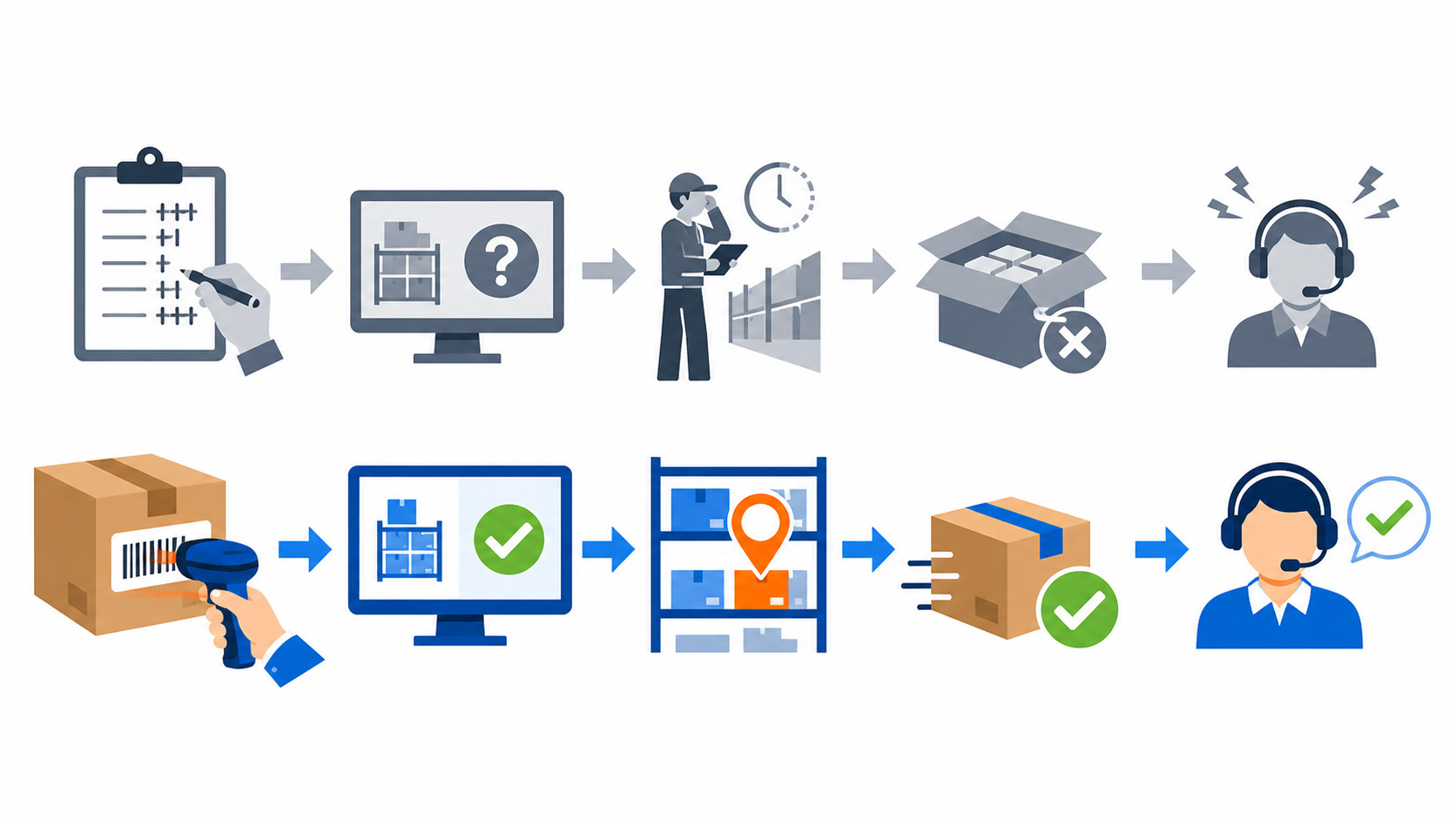
Inventory accuracy often breaks down when a growing operation depends on manual counts, floor checks, delayed updates, and after-the-fact corrections. Barcode scanning for inventory helps warehouse teams verify activity as work happens, so inventory records are not constantly rescued by people walking the floor.
This article is for businesses that are seeing more miscounts, order holds, customer-service questions, returns confusion, or shipping errors as volume grows.
The Inventory Number Everyone Wants to Trust
Every growing business wants to trust its inventory count. The first article explained what warehouse barcode scanning is; now the question is what happens when the business grows without that verification built into the workflow.
The owner wants to know what inventory value is sitting in the warehouse. Sales wants to know what can be promised. Customer service wants to answer questions quickly. Purchasing wants to know what needs to be replenished. Operations wants to know what is ready to move.
The number looks simple.
The work behind that number is not.
At a smaller stage, your team may be able to keep inventory accurate through careful counting, warehouse messages, spreadsheet checks, platform adjustments, and people who know where things are. That does not mean the process was wrong. It may have been exactly right for the stage your business was in.
Then growth changes the work.
More SKUs arrive. More orders enter the workflow. More people touch inventory. Returns come back. Wholesale or B2B orders create larger quantity decisions. Marketplace channels expect faster updates. Customer service needs answers while the warehouse is still working.
That is when the business starts learning a hard lesson:
Inventory accuracy cannot depend on rescue work forever.
When Manual Inventory Counts Stop Scaling
Manual cycle counts are useful. Physical checks are useful. Good warehouse people are useful.
The problem begins when manual counting becomes the main way your business discovers whether the system is wrong.
Cycle counting and scanning should work together. Cycle counts help confirm inventory over time. Scan-supported workflows help verify the daily activity that changes inventory in the first place.
At first, that may feel manageable. Someone walks to the shelf. Someone checks the pallet. Someone confirms the count. Someone updates the spreadsheet or messages customer service.
That effort can hide the problem once.
It cannot scale the model.
When inventory accuracy depends on repeated manual rescue, your team may start seeing patterns like:
- Customer service asking the warehouse to confirm available inventory.
- Orders waiting because the system and the shelf do not agree.
- Cycle counts finding problems that should have been caught earlier.
- Returned products sitting in uncertain status.
- Stock being corrected after a customer issue has already started.
- Multiple people checking the same inventory because nobody fully trusts the record.
- Leaders hesitating before adding another sales channel or larger customer.
Manual checks do not only cost time. They reveal that the inventory record is not trusted enough to support the speed of the business.
That is why barcode scanning for inventory becomes more important during growth. It helps the warehouse verify activity before the discrepancy becomes the workday.
The Real Problem Is Not the Count
An inventory count can be wrong for many reasons.
The item may not have been received correctly. It may have been placed in the wrong location. It may have been moved without an update. It may have been picked incorrectly. It may be damaged, returned, reserved, blocked, relabeled, or sitting in a staging area that the system does not reflect clearly.
Inventory accuracy is not only knowing how many units physically exist. A growing business also needs to know where the inventory is, how it moved, what status it is in, and whether it is usable for fulfillment.
Physical possession does not necessarily mean fulfillment-ready inventory.
Inventory may be physically inside the warehouse while still being damaged, awaiting inspection, approved for restock, requiring rework, tied to a return, or blocked by an exception or disposition decision.
That means the visible problem may be the count, but the deeper problem is the activity trail.
Where did inventory change?
When did it change?
Who confirmed it?
Was it the right item, quantity, location, and status?
If the warehouse cannot answer those questions from the workflow itself, your business may have to answer them manually after the pressure shows up.
This is the same operational lesson from the WMS article Why Basic WMS Software Breaks Down During Growth. Growth does not only increase volume. It increases the number of decisions your system has to support.
Inventory accuracy breaks down when those decisions depend on records that are not being verified as warehouse work happens.
How Delayed Updates Create Customer-Service Pressure
Customer service feels inventory problems quickly.
Your customer does not ask whether the warehouse completed a putaway scan. They ask whether the item is available. They ask when the order will ship. They ask why tracking has not updated. They ask whether a replacement can go out today.
If your inventory record is uncertain, your team may have to pause and ask the warehouse.
That pause can become routine:
- "Can someone check if this SKU is really available?"
- "Did this return pass inspection?"
- "Is this order short because the item is missing or because the system is wrong?"
- "Can we promise this wholesale quantity?"
- "Why does the marketplace show inventory that the warehouse cannot find?"
Those questions may look like customer-service work, but they often begin as warehouse verification gaps.
Barcode scanning does not replace customer service. It gives customer service a stronger record to work from. When receiving, picking, movement, returns, and cycle counts are scan-supported, your team has a better chance of seeing inventory status without waiting for another floor check.
Your customer gets a faster answer because your team is not always waiting for the warehouse to rediscover the truth.
How Miscounts Turn Into Fulfillment Mistakes
Some inventory errors stay invisible until the order is being fulfilled.
A picker goes to the location and the quantity is not there. A product looks similar to another item and the wrong SKU is selected. A carton contains a different count than expected. A pallet is staged in the wrong area. A return was placed back into stock before inspection was complete.
At low volume, your team may catch the issue before it reaches the customer.
At higher volume, the margin for manual correction gets smaller.
A warehouse mistake does not always happen one unit at a time.
In wholesale, B2B, carton, case, or pallet workflows, one verification failure can move substantially more inventory than intended. The wrong carton, wrong case count, wrong pallet, or wrong quantity can create a much larger correction than a single-unit pick error.
That does not mean warehouse employees are careless. It means growing operations ask skilled employees to manage more SKUs, similar packaging, multiple locations, changing priorities, customer-specific requirements, returns, exceptions, and shipping deadlines at the same time.
The better question is: what safeguards help a skilled employee catch a mistake before it travels downstream?
This is where mistakes become expensive. A customer may receive the wrong item. A marketplace order may miss a cutoff. A wholesale buyer may receive the wrong quantity. A carton or pallet may ship when the order only required a small quantity. Inventory may be corrected only after labor, freight, customer service, and replacement work have already been spent.
The problem is not only the mistake.
The problem is that the mistake moves.
A miscount can become:
- A picking delay.
- A packing correction.
- A missed shipment cutoff.
- A wrong shipment.
- A return.
- A customer-service case.
- A marketplace performance issue.
- A margin problem.
- A leadership distraction.
Barcode scanning for inventory helps reduce those risks by asking the warehouse to confirm the item, quantity, location, or task during the workflow instead of after the error has already traveled downstream.
Why Returns Make Inventory Accuracy Harder
Returns are one of the fastest ways to expose weak inventory controls.
A returned product may be physically inside the building, but that does not mean it is ready to sell. It may need inspection, grading, repackaging, relabeling, repair, customer approval, marketplace processing, or final disposition.
If that returned item is counted as available too early, your business may promise inventory it cannot actually ship. If it stays in limbo too long, sellable inventory may remain unavailable while customer demand continues.
The returns article How Returns & Exception Handling Works in Warehouse Operations explains why returned and exception inventory needs a controlled path from intake to resolution.
Scanning supports that control by helping the warehouse identify the item, connect it to the return or exception record, and move it through the correct status steps. That does not eliminate the need for human judgment. A worker may still need to inspect the product, check packaging, review damage, or decide whether the item can be restocked.
But scanning helps prevent returned inventory from becoming invisible inventory.
That matters because hidden inventory still creates cost.
As explained in Why Returns and Exceptions Create Hidden Warehouse Costs, unresolved inventory can consume space, labor, attention, and margin even when it is not moving toward a customer.
The Cost of Weak Barcode Scanning for Inventory
When barcode scanning for inventory is missing, inconsistent, or disconnected from the actual workflow, the cost does not always appear as one obvious failure.
It shows up as operational friction.
Labor Cost
Your team spends more time checking, correcting, recounting, messaging, and investigating.
That labor may not appear as a line item called "inventory uncertainty," but it still affects the business. People who should be moving orders, serving customers, receiving inventory, or planning growth get pulled into verification work.
Customer Cost
Customers wait longer for answers.
If inventory is uncertain, your team may hesitate before making promises. Orders may sit on hold. Replacement shipments may take longer to approve. Marketplace updates may be less reliable. The customer may experience the inventory problem as delay, confusion, or disappointment.
Inventory Cost
Inventory can be physically present and still not be useful.
It may be in the wrong location, the wrong status, the wrong packaging, the wrong count, or the wrong workflow. Without scan-supported control, your business may not know which inventory is truly available, which is blocked, and which needs attention.
Growth Cost
Leadership becomes cautious.
Adding a marketplace, SKU line, wholesale account, retail program, or higher order volume feels riskier when inventory accuracy already depends on manual rescue. The business may still have opportunity, but the operating model makes the opportunity harder to trust.
Barcode Scanning Helps Only When the Workflow Uses It
It is tempting to think the answer is simply "add scanners."
That is not enough.
A warehouse can own scanners and still have weak inventory control if workers bypass scan steps, labels are inconsistent, product data is wrong, exceptions are not handled clearly, or scans do not update the right system records.
Barcode scanning becomes powerful when it is part of a disciplined workflow.
The warehouse needs to know:
- What must be scanned.
- When it must be scanned.
- What the scan is confirming.
- What happens if the scan does not match.
- Which status changes should be updated.
- Which exceptions need review.
- Which information becomes visible to the customer-facing system.
That is the difference between scanner ownership and scan-supported inventory control.
The goal is not to make the warehouse look more technical. The goal is to reduce the number of moments where inventory accuracy depends on someone remembering, guessing, checking later, or correcting the record after the customer problem has already started.
When a scan or warehouse activity identifies an exception, the system should not pretend the issue is solved automatically. The exception needs to be flagged, and warehouse staff or inventory-control personnel may need to physically investigate, verify, and resolve the discrepancy.
Scanning adds safeguards. People still handle the judgment and execution.
Why Businesses Consider a 3PL When Inventory Accuracy Slips
Inventory uncertainty is one of the reasons a business may start considering a stronger 3PL logistics partner.
The issue is not always warehouse space. It is not always labor. It is not always software.
Often, the issue is confidence.
Your business needs to know whether the inventory record can support the work being asked of it. Can the warehouse receive accurately? Can it place inventory where the system expects it? Can it pick the correct SKU and quantity? Can it update returns status? Can it confirm inventory movement? Can it keep customer-facing information current enough for your team to trust?
When the answer is unclear, growth starts to feel fragile.
The right 3PL conversation should include more than storage rates and shipping zones. It should include how the provider verifies warehouse activity and how scan-supported workflows connect to inventory accuracy, order execution, and visibility.
That is where barcode scanning becomes part of the bigger operating model.
EOS maintains 99.83% inventory accuracy through disciplined inventory-control processes supported by scan-based warehouse execution, location verification, inventory status control, cycle counts, exception handling, and human oversight.
That number is not a promise that scanning alone creates perfect accuracy. It is a proof point for the operating principle this article has been explaining: inventory accuracy depends on the way physical warehouse activity is verified, controlled, reviewed, and corrected as work happens.
The Better Question
The first article explained what warehouse barcode scanning is and why the barcode on the box matters.
This article shows why the pressure builds when inventory accuracy depends too heavily on manual counts and delayed updates.
The better question is not whether a warehouse owns scanners.
The better question is whether warehouse activity is being verified consistently enough to protect inventory accuracy as your business grows.
When manual rescue becomes part of the workday, your team is no longer just dealing with inventory errors. It is dealing with an operating model that cannot keep proving what happened.
The next article looks at the stronger model: how warehouse barcode scanning, WMS, and OMS work together in 3PL fulfillment.
Frequently Asked Questions
What is barcode scanning for inventory?
Barcode scanning for inventory uses scannable labels and scanning devices to verify products, quantities, locations, movements, returns, or warehouse tasks. Barcode scanning helps inventory records stay closer to what is physically happening in the warehouse.
Why does inventory accuracy break down without warehouse barcode scanning?
Inventory accuracy breaks down when warehouse activity depends too much on manual counts, memory, paper notes, delayed updates, and after-the-fact correction. As volume grows, those methods become harder to scale and easier to distrust.
Can manual cycle counts still be useful?
Manual cycle counts can still be useful, especially as part of a disciplined inventory-control program. The problem begins when manual cycle counts become the main way a business discovers errors that should have been caught during daily warehouse activity.
How can inventory miscounts affect customer orders?
Inventory miscounts can cause order holds, picking delays, wrong shipments, missed cutoffs, stockouts, returns, customer-service cases, and marketplace pressure. The cost depends on the situation, but the risk grows when the system and warehouse floor do not agree.
Does barcode scanning prevent every warehouse error?
Barcode scanning does not prevent every warehouse error by itself. It works best when labels, product data, system workflows, scan discipline, exception handling, and warehouse training all support the same process. When a scan identifies a mismatch or exception, warehouse or inventory-control personnel may still need to physically review and resolve the issue.
Does barcode scanning replace warehouse employees?
No. Barcode scanning supports warehouse employees by adding direction, verification, and safeguards during physical work. People remain essential for handling inventory, inspecting products, investigating exceptions, making judgment calls, and executing the warehouse workflow.
Why are returns hard to manage without scan-supported workflows?
Returns are hard because returned inventory may be physically present but not ready to sell. Scan-supported workflows help identify returned items, connect them to the right status, and move them through inspection, recovery, restock, or resolution.
When should a business consider a 3PL for inventory accuracy problems?
A business should consider a stronger 3PL model when manual counts, inventory corrections, warehouse checks, returns uncertainty, shipping errors, and customer-service delays are becoming normal parts of the workday.
Discover more from Enterprise Order Solutions
Subscribe to get the latest posts sent to your email.