Estimated read time: 9 min
Basic WMS software can feel like the right next step until growth creates more orders, SKUs, sales channels, returns, and exceptions than the system can reliably support. This guide explains how WMS visibility gaps turn into manual work, delays, inventory risk, customer pressure, and operational uncertainty.
At first, basic WMS software may feel like the next step.
Your team can see inventory. Orders have somewhere to go. Warehouse activity has a system instead of a spreadsheet. Your operation feels more organized than it did before.
Then your business grows.
More SKUs enter the warehouse. More sales channels start pulling from the same inventory. More returns need review. More orders depend on accurate status. More customer promises depend on what the system says is available.
That is when the visibility gap starts working against you.
A WMS breakdown does not always mean the software crashes or stops running. More often, it means your operation increasingly depends on manual checks, disconnected updates, exception handling, and human intervention to compensate for what the system cannot control.
In Not All Warehouse Management Systems Are Created Equal, we established that having a WMS does not reveal how much operational control the system provides. Article 2 examines what happens when that capability no longer matches the work.
What happens when the system that once helped your operation starts limiting what you are trying to build?
Why Basic WMS Software Breaks Down as Order Volume Grows
Order volume exposes weak systems because every order asks the warehouse the same question.
Is the inventory ready?
When order volume is low, your team may be able to answer that question manually. Someone checks a shelf, confirms a carton, reviews a spreadsheet, sends a message, or asks the warehouse to verify the item before the order moves.
That effort can hide the problem once.
It cannot scale the model.
As order volume grows, every small visibility gap creates more work. A missing location update delays picking. A receiving delay keeps orders from being released to the warehouse floor. A return that is not inspected leaves inventory in limbo. A manual inventory adjustment creates uncertainty for customer service. A marketplace order needs an answer before your team has confidence in the data.
The issue may not be that your team is careless. It may not be that the warehouse is failing. It may be that the system was never built to control the level of activity your business now depends on.
Growth does not only increase volume. It increases the number of decisions your system has to support.
Which inventory is actually available? Which orders are ready for warehouse release? Which warehouse location should fulfill each order? Which units have already been committed to another channel or order? Can a returned unit be resold? Does an exception block shipment? Is the latest warehouse update current enough to trust?
Picture a Monday morning with several promises competing for the same inventory. Shopify orders begin entering the workflow. Amazon demand begins drawing from the same inventory pool. A wholesale customer asks whether a larger quantity can ship this week. Returned units are physically in the warehouse, but they have not been inspected yet.
The question is no longer whether the building contains inventory. The question is which inventory can support which promise.
How the Inventory Control Gap Spreads Across the Workflow
The inventory control gap rarely announces itself as one major failure. It usually appears as small moments of doubt.
Your team sees inventory available, but the order does not ship. The warehouse says product is on hand, but the location is unclear. Customer service sees one status, while the warehouse is working from another. A returned item appears in the building, but no one is sure whether it is sellable, damaged, blocked, or waiting for review.
At first, those issues feel like exceptions.
Then they become part of the workday.
Inventory control depends on more than quantity. Your business needs to know location, status, availability, reservation, damage condition, return status, and fulfillment readiness. If basic WMS software only shows part of that picture, your team may still have visibility without control.
We covered this foundation in Inventory Control Isn’t Just a Metric. The count matters, but the operational confidence behind the count matters more.
That confidence becomes harder to protect when your system does not reflect the real warehouse floor. If receiving, putaway, picking, packing, returns, exceptions, and cycle counts do not update correctly, the dashboard becomes less useful over time.
The data may exist.
Your team may still not trust it.
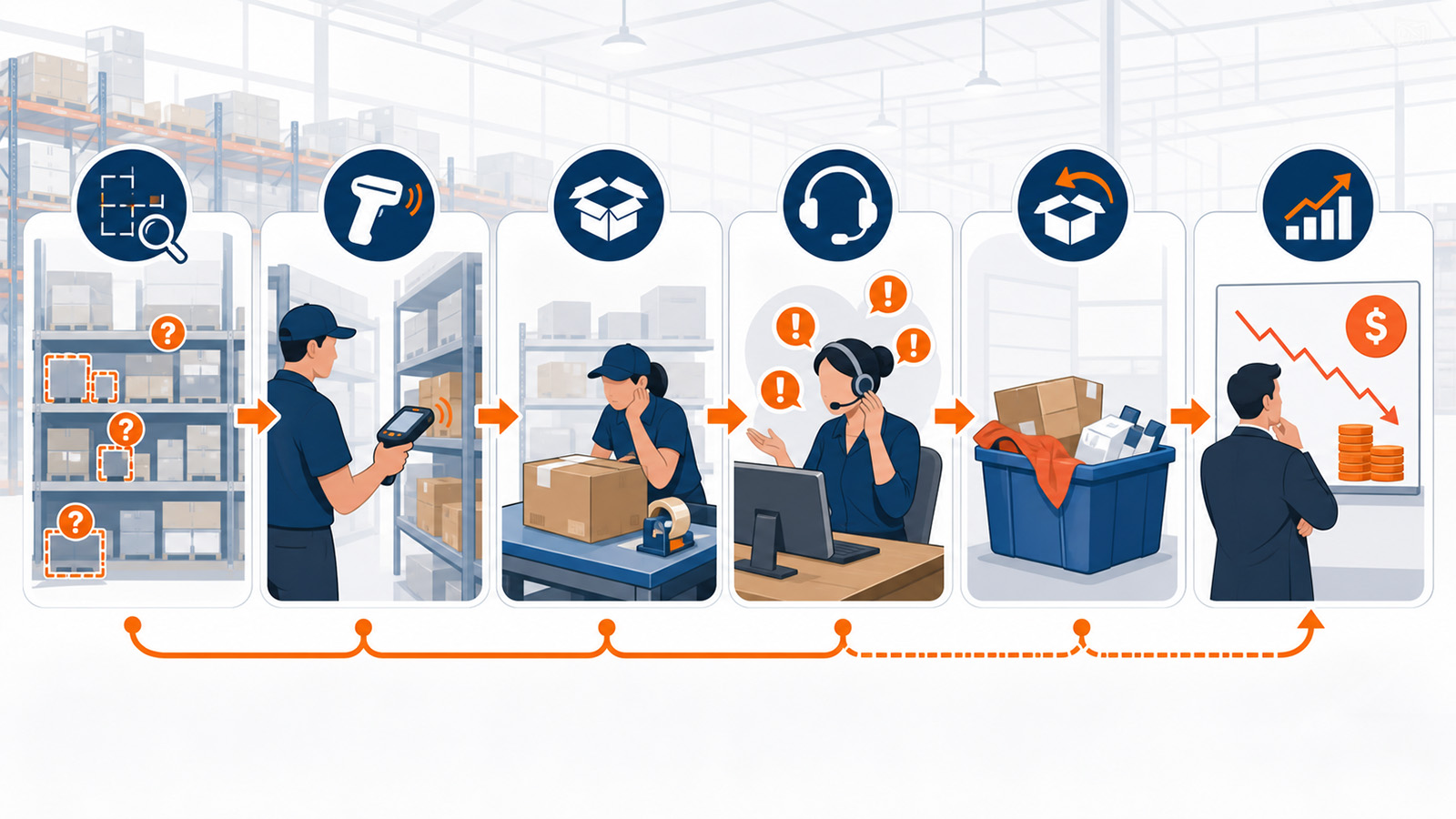
A missing putaway update begins as a location problem. It becomes a picking delay, then a missed shipping cutoff, then a customer-service question. Not every visibility gap creates every possible consequence, but the pattern is familiar: visibility gap, manual workaround, workflow delay, customer effect, business cost.
Why Multichannel Order Growth Exposes Weak Warehouse Systems
Multichannel growth makes basic system gaps harder to contain.
When your business sells through one channel, a weak process may only affect one order stream. When your business sells through Shopify, Amazon, Walmart, Wayfair, eBay, wholesale buyers, or retailer relationships, the same inventory pool may support several different promises at the same time.
Each channel creates its own pressure.
Marketplace orders may need accurate inventory, FBA prep, FBM fulfillment, tracking updates, and account-health protection. Ecommerce customers may expect fast shipment and clear communication. Wholesale buyers may need pallet preparation, labeling, routing discipline, and reliable outbound coordination.
If your system cannot keep inventory and order activity aligned, your team starts managing the gaps manually.
That is where growth becomes tiring. Your business is selling through more channels, but your operation is spending more time chasing status, correcting errors, checking inventory, and protecting customer expectations after the fact.
For a broader look at how channel growth creates fulfillment strain, the related guide Why Ecommerce Fulfillment Problems Get Worse Across Multiple Sales Channels explains how more order paths can turn small fulfillment gaps into larger business pressure.
If marketplace channels are part of your growth, this pressure can become even more visible. We covered that pattern in Why Marketplace Fulfillment Problems Put Seller Growth at Risk, where inventory pressure, prep issues, shipping deadlines, and tracking gaps can spread across your marketplace workflow.
WMS capability matters because multichannel growth depends on synchronized truth.
If the system cannot keep up, your business may still be growing while operational confidence starts shrinking.
When Returns and Exceptions Outgrow Basic Software
Returns and exceptions often reveal whether your WMS can support the full inventory lifecycle.
It is one thing to track inventory that arrives cleanly, stores correctly, and ships without interruption. It is another thing to manage inventory that comes back, arrives damaged, needs inspection, requires relabeling, waits for grading, or needs a final disposition decision.
Basic WMS software may not provide the status depth, workflow support, or exception visibility needed to manage that complexity consistently.
Returned inventory can sit in a gray area. Exception inventory can consume space without becoming usable. Damaged goods can appear in the warehouse but remain unavailable. Rework can happen manually without clear status updates.
That is why returns and exceptions should not be treated as side activity. They affect inventory accuracy, labor planning, customer service, margin recovery, and warehouse control.
In the related returns article, Why Returns and Exceptions Create Hidden Warehouse Costs explains how unresolved inventory can spread cost across space, labor, accuracy, customer communication, and recovery value.
The same lesson applies to WMS growth. If your system does not handle exceptions clearly, your operation may become less predictable every time inventory falls outside the standard path.
The pressure is not only inside the warehouse. It moves into customer service, leadership decisions, and the confidence your team has when accepting the next growth opportunity.
Frequently Asked Questions About Basic WMS Software
What does it mean when basic WMS software breaks down?
Basic WMS software breaks down when your operation increasingly depends on manual checks, disconnected updates, exception handling, and extra human intervention to complete work the system should support. The software may still be running, but the workflow becomes less reliable.
Why does basic WMS software break down during growth?
Basic WMS software can break down during growth because more SKUs, orders, channels, returns, exceptions, and locations create more operational decisions. A system that only tracks simple inventory may not support the control needed for higher-volume warehouse execution.
What are common WMS software problems?
Common WMS software problems include weak location tracking, unclear inventory status, delayed receiving updates, manual order workarounds, poor return visibility, disconnected sales channels, limited exception handling, and inventory records that do not match warehouse reality.
How do WMS visibility gaps affect inventory control?
WMS visibility gaps affect inventory control by making it harder to know whether inventory is available, reserved, damaged, returned, blocked, received, or ready to ship. The system may show inventory, but your team may still need manual checks before acting on it.
Why does multichannel growth create WMS pressure?
Multichannel growth creates WMS pressure because several sales channels may depend on the same inventory pool. Shopify, Amazon, Walmart, Wayfair, eBay, wholesale, and retailer orders all need accurate inventory data, order status, and warehouse execution updates.
Can returns and exceptions create WMS problems?
Yes. Returns and exceptions create WMS problems when inventory comes back, needs inspection, requires grading, waits for rework, or needs a final disposition decision. If the system does not track these statuses clearly, returned inventory can weaken inventory accuracy and warehouse control.
What happens if a business ignores WMS visibility gaps?
If visibility gaps are ignored, your operation often becomes more manual and reactive. Your team may spend more time checking inventory, chasing order status, resolving exceptions, and protecting customer promises after problems have already appeared.
When should a business consider a stronger WMS model?
A business should consider a stronger WMS model when inventory, warehouse work, order flow, returns, exceptions, and customer expectations have become too complex to manage with basic software or internal workarounds.
What is the next topic after basic WMS software?
The next topic is choosing the right WMS model for your operation. Continue with Which Warehouse Management System Is Right for Your Business?.
Discover more from Enterprise Order Solutions
Subscribe to get the latest posts sent to your email.