
Estimated read time: 11 min
A 3PL transportation management model should connect prepared orders, warehouse release, freight quotes, carrier coordination, tracking, and exception ownership. This guide shows how an LTL or B2B shipper can evaluate costs before committing to a freight order, then plan and schedule a move that fits its delivery requirements. It is for businesses whose current process is struggling to keep pace with more varied destinations and buyer promises.
The Last Scan Is the Start of Another Promise
In the previous article, we saw how transportation work becomes harder when every carrier choice, pickup, and shipment update has to be assembled from separate places. The warehouse barcode scanning series ended at the last verified warehouse action. The WMS series explained physical execution; the OMS series explained how an order becomes ready for that work.
Your customer is still waiting for the order.
That is the opening a transportation management system must close. The carton or pallet may be ready, but someone still has to choose the service, communicate with the carrier, confirm the handoff, watch the move, and respond when the plan changes. A 3PL should be able to explain how those steps connect, not merely show you a dashboard after the fact.
The useful evaluation question is: who owns the decision from warehouse release to delivery, and what information can you trust along the way?
A Connected Transportation Model Begins Before Booking
The transportation plan should inherit facts from the order and warehouse, not ask a shipping desk to rediscover them. The order may carry a promised date, customer label, retailer routing guide, service preference, or delivery instructions. Warehouse execution should confirm the actual cartons, pallet count, weight, dimensions, and readiness status as applicable.
With those facts, the team can decide whether the shipment belongs in parcel, LTL, FTL, regional delivery, or another appropriate service. It can then check the carrier and service against destination, timing, buyer rules, and total shipment needs.
This is where the three systems have distinct jobs:
- OMS organizes the order and customer requirements.
- WMS and scan-supported work confirm what the warehouse physically prepared.
- TMS supports the transportation plan, carrier handoff, and shipment progress.
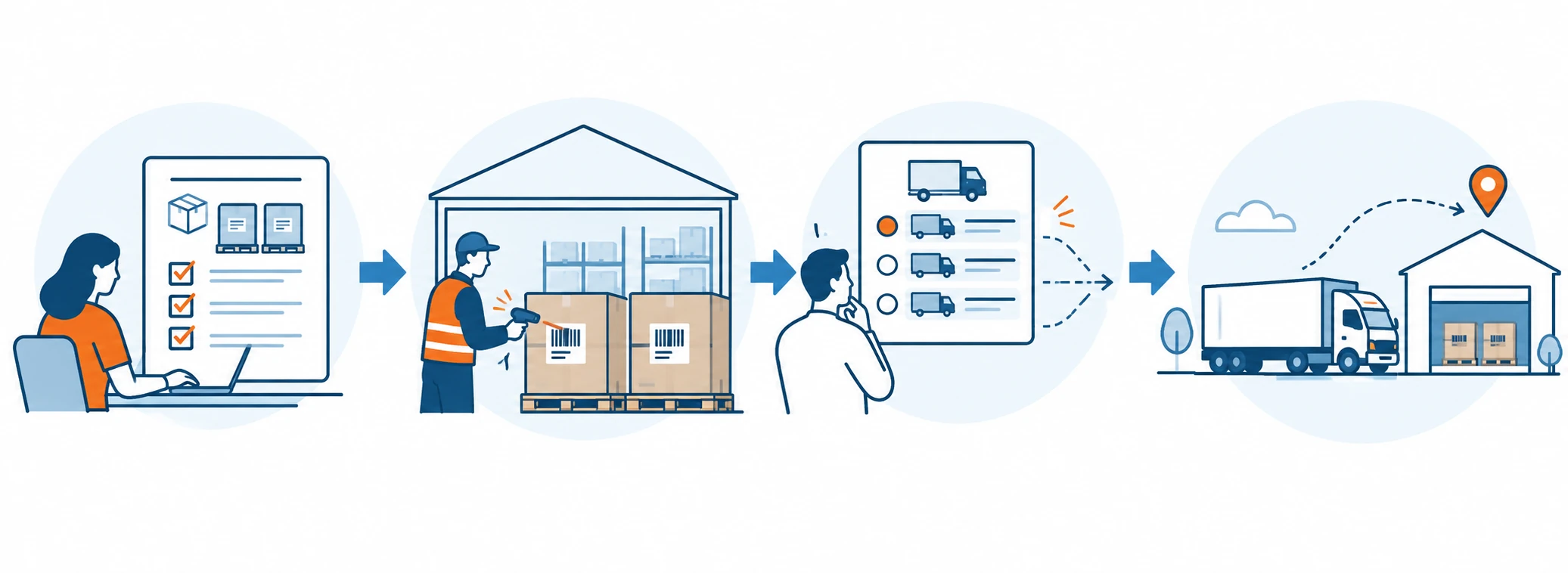
The labels matter less than the handoffs. If the warehouse record says two pallets while the transportation booking says one, the customer does not benefit from three connected logos on a diagram. Someone has to resolve the mismatch before pickup.
How an LTL Freight Quote Supports Business Planning
Suppose your business is considering an order that would require two pallets to Houston. Before you promise delivery or set a price for your buyer, you want to understand the freight cost and timing. That is a business decision, not yet a freight order.
EOS customers can enter the shipment details in the TMS inside their OMS client portal and request a quote. The system returns a quote reference and a validity window, so the customer knows when that quoted option can inform the plan. The customer does not have to create a freight order just to get that information.
That separation matters. You can compare the transportation cost with the value of the sale, check whether the delivery plan fits the buyer’s needs, and decide what to do next. When the freight move is approved, the same tool can be used to plan and schedule it.
For a B2B shipper, the ability to ask “What would this move cost, and how long is this quote valid?” before committing can protect a margin decision. It can also help a team explain its shipping choice to a buyer or account owner with a real reference instead of an estimate buried in email.
Carrier Choice Should Match the Job
Ask a prospective 3PL how it chooses transportation for different shipments. A thoughtful answer should account for more than a rate table.
For a parcel, service level and delivery promise may lead the decision. For a wholesale shipment, the buyer may specify a carrier, labels, documentation, and an appointment. A bulky or fragile product may need a service with particular handling. A local delivery may be better served by a regional operation. An urgent shipment may justify a higher transportation cost to protect a buyer relationship.
Your business should be able to keep using its own carrier account or customer-supplied label when the agreement requires it. A 3PL’s carrier options should add choices, not erase the obligations you already have.
EOS customers may use EOS transportation accounts or provide their own shipping labels and accounts. EOS supports LTL, FTL, and eligible Southern California regional delivery. Its TMS is particularly useful for LTL and B2B freight planning; it is not merely a parcel-label screen. EOS has recently added Priority1 as a transportation partner in the TMS. The exact option still depends on the shipment, customer agreement, service area, and operating requirements.
Status Is Useful When Someone Can Act on It
The customer sees a delay; your team needs to know what to do. That calls for more than a tracking link.
Ask how the 3PL distinguishes a label from a pickup, a carrier acceptance from an in-transit update, and a delivery estimate from confirmed delivery. Ask what happens when a status is missing or a delivery appointment slips. Ask who notices, who contacts the carrier, who informs your team, and what evidence closes the case.
The right answer may differ by parcel, LTL, truckload, and regional delivery. The important point is accountability. When the shipment crosses from EOS-controlled warehouse work to an outside carrier, the process should say where visibility comes from and who follows up when a handoff is unclear.
EOS customers can receive live tracking updates through the client portal. The detail available for a parcel, LTL shipment, truckload, or regional delivery may differ. An honest status view is more useful than a vague promise of real-time GPS everywhere.
The People Behind the System Matter
A business can buy transportation software and still spend its day resolving unanswered questions. Software helps repeat known rules. People handle the situations the rules do not cover: a late pickup, changed appointment, damaged shipment, new buyer instruction, or carrier that declines a load.
EOS assigns each customer an account manager who learns the business and its logistics requirements during onboarding. Together, they can set or update shipping policy rules so the transportation workflow reflects what matters for that account: value, a required delivery date, cost savings, or route efficiency. A B2B pallet program may set different priorities from an ecommerce seller’s parcel flow. The account manager represents your priorities inside EOS; transportation and warehouse teams still perform their own operational roles.
Customers can log in and review their transportation options for themselves. The account manager remains available when a rule needs to change or an unusual shipment needs a person to work through it.
When evaluating any 3PL, ask what is configured during onboarding, what your team can view or change, and how new requirements are reviewed. A good answer should be specific enough that you can picture your first difficult shipment, not only your first easy one.
When 3PL Transportation Management Is the Right Fit
EOS connects warehousing, fulfillment, transportation coordination, and distribution. Its current Transportation & Distribution page describes shipment readiness review, mode selection, pickup scheduling, carrier coordination, LTL and FTL movement, delivery coordination, and status through completion. It also describes an EOS-operated regional delivery company for eligible Southern California routes.
EOS-OMS includes the TMS in its customer client portal. With one login across applicable EOS facilities, customers can view order and inventory information, request LTL freight quotes, and plan and schedule transportation. That connected view helps your business follow an order from intake and warehouse execution into the transportation stage with less manual reconciliation.
That may be valuable when your company is moving wholesale pallets, retailer orders, and recurring distribution freight, especially when you need a cost reference before committing to a B2B sale. It may also be valuable when you need a partner to manage the warehouse-to-carrier handoff while your team stays focused on selling, customer relationships, and growth.
It is not necessarily the right fit if you only need a standalone shipping application for a small, simple parcel operation, or if you plan to keep all warehousing and transport execution entirely inside your own team. In that case, compare software and process improvements against a full 3PL model.
Questions to Ask a 3PL About Transportation Management
Before choosing a 3PL transportation model, ask for a walkthrough of one ordinary shipment and one exception:
- What order information reaches transportation planning automatically, and what must be checked manually?
- What warehouse facts are confirmed before booking or label creation?
- How are preferred carriers, buyer routing, customer labels, and service commitments applied?
- Which modes and destinations does the partner support directly or through carriers?
- How do pickup, in-transit, exception, and delivery events reach your team?
- Who owns a missed pickup, changed appointment, or delivery exception?
- Can your company see the reason behind a transportation choice and review its performance later?
The answers reveal the operating model. A feature list cannot show whether a warehouse-ready order stays connected to the customer promise once it leaves the dock.
How Regional Carriers Can Partner With a 3PL
A TMS can also help a logistics provider work with transportation partners by sharing shipment requirements, acceptance, status, and delivery information. The process works best when carriers know what information the shipper needs and how to return it.
Smaller regional carriers interested in quoting on the EOS TMS can use the Contact EOS form. Share your service area and the types of freight you handle so the EOS team can discuss whether there is a fit.
The Next Chapter: Ecommerce and ERP Data
Transportation does not end the information journey. Your ecommerce channel may need shipment confirmation and tracking. Your order team may need delivery status. An ERP may need order, shipment, or other operational data for the business processes it owns.
That next series can examine how data crosses ecommerce, OMS, WMS, TMS, and ERP boundaries. It should explain where an API, EDI connection, or custom integration helps keep the same order story consistent. It should also distinguish operational data exchange from accounting functions, which are outside the current EOS claim set.
For this series, the conclusion is practical. Your business does not have to run every carrier portal and warehouse handoff itself to keep a clear view of its shipments. It does need a partner that can show how a prepared order becomes a planned move, how that move is monitored, and who acts when delivery needs help.
If your company is evaluating that level of transportation support, review EOS’s Transportation & Distribution solution and discuss a representative shipment with the team. Bring the real buyer rules, delivery windows, account preferences, and status questions your business faces. That is the fastest way to learn whether the model fits.
Frequently Asked Questions
Do EOS customers have access to the TMS?
Yes. EOS customers can access the connected TMS through their OMS client portal. They can request live freight quotes to plan or price shipments without creating a freight order. The quote includes a reference number and validity window; customers can plan and schedule the move when they are ready.
Can a customer use its own carrier account with a 3PL?
Many 3PL arrangements allow customer-provided labels or carrier accounts, subject to the agreement and workflow. EOS supports customer-provided labels and accounts as well as EOS transportation accounts. Confirm the handling for each mode and buyer program during onboarding.
What should I ask about a 3PL’s carrier network?
Ask which modes, destinations, and service types the partner handles; when it uses its own regional capability versus an outside carrier; how customer accounts and buyer routing rules are honored; and who owns exceptions after carrier handoff.
What does real-time transportation visibility mean?
It means the team receives timely, useful shipment events and can act on them. The update frequency and detail depend on the carrier, mode, and integration. Ask whether a status means a label was created, a carrier picked up the freight, the shipment is in transit, or delivery was confirmed.
How can ERP integration support transportation?
ERP integration can exchange relevant order and shipment data with operational systems through supported connections such as APIs or EDI. What is exchanged depends on the ERP, integration, and customer workflow. It does not imply the 3PL provides accounting services.
How can transportation companies apply to join the EOS TMS?
Transportation companies interested in quoting on the EOS TMS can use the Contact EOS form. Include your service area and the freight types you handle so the EOS team can review whether your services fit its transportation needs.
Discover more from Enterprise Order Solutions
Subscribe to get the latest posts sent to your email.