
Estimated read time: 10 min
3PL fulfillment services work best when order visibility and warehouse execution stay connected. This guide explains how an OMS supports order flow, how a WMS supports warehouse activity, and why growing ecommerce, marketplace, wholesale, and B2B brands need fulfillment partners whose systems, warehouse teams, shipping workflows, and account support can keep customer commitments aligned as the operation becomes more complex.
The Fulfillment Handoff Between OMS and WMS
By the time your business starts evaluating 3PL fulfillment services, the question is rarely only about warehouse space.
Space matters. Labor matters. Location matters. Shipping options matter.
But growing ecommerce, marketplace, wholesale, and B2B brands usually need something deeper:
Can this fulfillment partner keep order flow, inventory visibility, warehouse execution, and customer-facing information aligned as the business grows?
That is where OMS and WMS visibility become important.
An order management system helps organize order flow. A warehouse management system helps support warehouse execution. In a 3PL fulfillment model, both sides need to work together.
If the order side is disconnected from the warehouse side, your business may still ship orders, but it will keep fighting the same problems: manual checks, unclear inventory commitments, delayed customer updates, and exception work that steals time from growth.
Article 2, Why Ecommerce Order Management Breaks Down During Growth, showed how ecommerce order management breaks down when growth creates more decisions than the workflow can support. Article 3 begins at the next decision point.
Your business is no longer asking only whether it needs better software.
You are asking whether the fulfillment model can keep orders, inventory, warehouse execution, shipping activity, and human support connected when the work gets more complex.
The right question is not:
Does the 3PL have software?
The better question is:
How do the 3PL’s systems, warehouse workflows, and support team keep orders and inventory connected as work happens?
OMS and WMS solve different parts of the fulfillment problem.
The OMS organizes the order side. The WMS supports the warehouse side.
For 3PL fulfillment services to work well, those systems need to create a dependable connection between what the customer ordered, what inventory is available, what the warehouse needs to do, and what status your business can trust.
That connection supports the practical work of fulfillment:
- Orders entering from ecommerce stores, marketplaces, wholesale accounts, API connections, EDI workflows, or direct channels
- Inventory being received, stored, moved, picked, packed, returned, or held
- Warehouse teams understanding what needs to happen next
- Customer service understanding what has happened already
- Operations leaders seeing whether the model can keep supporting growth
Software alone does not create fulfillment discipline.
But disconnected software makes disciplined fulfillment harder.
That is the tension this article is meant to resolve.
The right 3PL model should help the order side and warehouse side stay connected without asking your team to become the permanent bridge between them.
For broader channel context, the EOS guides on Ecommerce Fulfillment & 3PL Services and Wholesale & B2B Distribution Logistics explain how direct-to-consumer and B2B order paths create different operational requirements.
What the OMS Controls Before Warehouse Execution
An OMS supports the order side of ecommerce and B2B fulfillment.
It helps organize order information before that order becomes warehouse work.
Depending on the operating model, an OMS may support:
- Order intake from sales channels, API connections, and EDI workflows
- Customer and shipping information
- Order status visibility
- Fulfillment path coordination
- Holds, edits, cancellations, and exceptions
- Inventory availability context
- Customer-facing order information
- Communication between order flow and warehouse execution
This is why OMS visibility matters before the warehouse starts picking.
The warehouse team should not have to guess which orders matter, which channel created them, what customer requirements apply, or whether the order is ready for execution.
The order system should help make the work clearer before it reaches the warehouse floor.
What the WMS Controls During Warehouse Execution
A WMS supports the physical warehouse side of fulfillment.
It helps control the work that changes inventory reality.
Depending on the system and workflow, a WMS may support:
- Receiving
- Putaway
- Internal location tracking
- Inventory status updates
- Scan-supported warehouse activity
- Picking
- Packing
- Returns
- Exceptions
- Transfers and inventory movement
This is where WMS inventory visibility becomes operational.
Inventory is not only a number on a screen. It is product that has to be received, verified, stored, located, prepared, picked, packed, returned, moved, or held.
The WMS helps support that physical control.
The OMS may know an order exists. The WMS helps support whether the warehouse can act on that order accurately.
If you want the warehouse-side foundation first, start with Not All Warehouse Management Systems Are Created Equal. The broader Warehouse Management Systems & Inventory Control guide also explains how WMS visibility fits inside warehouse storage and inventory control.
For the pressure side of the WMS story, Why Basic WMS Software Breaks Down During Growth explains what happens when warehouse systems no longer match the work.
The related EOS solution page for Warehouse Receiving & Inventory Control explains the receiving and inventory-control side of the operating model.
Platform Architecture: From Order Intake to Warehouse Execution
A strong fulfillment workflow needs a clean path from order intake to warehouse execution.
For a growing brand, the path may look like this:
- Ecommerce stores and marketplaces create customer orders.
- API and EDI workflows help structured order data enter the order management process.
- The OMS organizes order status, customer requirements, inventory context, and fulfillment readiness.
- The WMS supports the physical warehouse work required to receive, locate, pick, pack, return, and move inventory.
- Shipping and status updates help the business understand what happened and what still needs attention.

This is the platform architecture idea behind connected fulfillment.
The value is not that every system has a name.
The value is that data can move through the operation in a way your team can trust.
Real-time data flow, end-to-end visibility, and automated processes are useful only when they stay connected to actual warehouse work. If the system says an order is ready but inventory is blocked, the system is not telling the whole story. If the warehouse updates inventory but the order workflow does not reflect that change, customer service still has a visibility problem.
The goal is connected operating truth.
Orders, inventory, warehouse activity, and customer-facing status need to tell the same story.
That is what separates a useful platform architecture from a collection of disconnected tools.
How EOS-OMS Connects Marketplaces, ERP Systems, API, EDI, and Shipping Platforms
Integration matters because orders do not all enter the business through the same door.
Some orders may come from ecommerce stores, marketplaces, wholesale accounts, retailer systems, ERP workflows, API connections, EDI workflows, or shipping platforms.
EOS-OMS is built to support connected order flow across these types of workflows where configured.
EOS has documented direct integrations with Wayfair, eBay, and Walmart. EOS also supports ShipStation-connected workflows for storefronts such as Shopify, Amazon, and WooCommerce, along with ERP/API-connected workflows such as Sellercloud where configured.
Other supported or configured workflows may also be available depending on the account requirements. If your business needs a custom integration that is not already in place, EOS can evaluate, configure, or build the workflow your operation needs where required.
The benefit is not only connection.
The benefit is order control.
When integrations are connected to EOS-OMS and EOS-WMS-supported execution, your business can improve order validation, inventory allocation, fulfillment readiness, warehouse execution, shipping data, customer notifications, tracking visibility, and reporting.
How ShipStation Fits Into Connected Fulfillment Workflows
ShipStation is useful because many ecommerce and marketplace sellers already rely on it to connect stores, shipping labels, carrier options, tracking updates, and shipping workflows.
For some EOS customers, ShipStation-supported integrations can help connect an internal OMS, marketplace channels, ecommerce platforms, and shipping activity into the broader fulfillment process.
That matters because shipping is not the last step in a vacuum.
The shipping decision depends on order data, inventory allocation, warehouse readiness, label requirements, carrier requirements, and customer expectations. EOS-OMS provides order visibility and coordination, while EOS-WMS-supported warehouse execution helps the physical work move correctly.
Together, that gives the customer more than a label workflow.
It gives the customer a clearer way to understand orders, inventory, warehouse execution, shipping status, and tracking information as the work moves.
Why Order Visibility and Inventory Visibility Must Align
Order visibility and inventory visibility are useful separately.
They become powerful when they align.
If your team can see orders but cannot trust inventory readiness, customer commitments become risky. If your team can see inventory but cannot connect it to order flow, fulfillment decisions become slower. If warehouse execution updates inventory but order visibility does not reflect the change clearly, customer service may still be stuck.
This is why growing brands need more than disconnected dashboards.
They need connected operating truth.
For example:
- A Shopify order enters the workflow.
- Amazon demand draws from the same inventory pool.
- A wholesale order asks for a larger quantity.
- Returned units are physically present but still need review.
- The warehouse has inventory, but not all units are ready for the same promise.
At that moment, your business needs order visibility and inventory visibility to support the same decision:
Which orders can move, which inventory can support them, and what needs attention?
That is the point where OMS and WMS connection becomes more than a software feature.
It becomes an operating requirement.
How Connected Systems Support Fulfillment Readiness
Fulfillment readiness is the condition where an order has enough clean information and available inventory to move into warehouse execution.
It sounds simple.
In real operations, it can be complicated.
The order may need the right address, label method, channel rules, preparation instructions, shipping method, buyer requirement, or customer-specific routing note. The inventory may need to be received, verified, located, picked, packed, or cleared from a return or exception status.
Connected OMS and WMS visibility helps reduce uncertainty around those steps.
The OMS supports the order side:
- Where the order came from
- What the customer requires
- What status the order is in
- Whether the order is ready to move forward
The WMS supports the warehouse side:
- Where the inventory is
- What status it is in
- What warehouse work has happened
- What warehouse action needs to happen next
Together, they help support order fulfillment services that are more visible, more coordinated, and easier to manage as the business grows.
What to Look for in a 3PL With OMS and WMS Visibility
When evaluating a 3PL, do not stop at the phrase “we have technology.”
Ask how the technology supports the work.
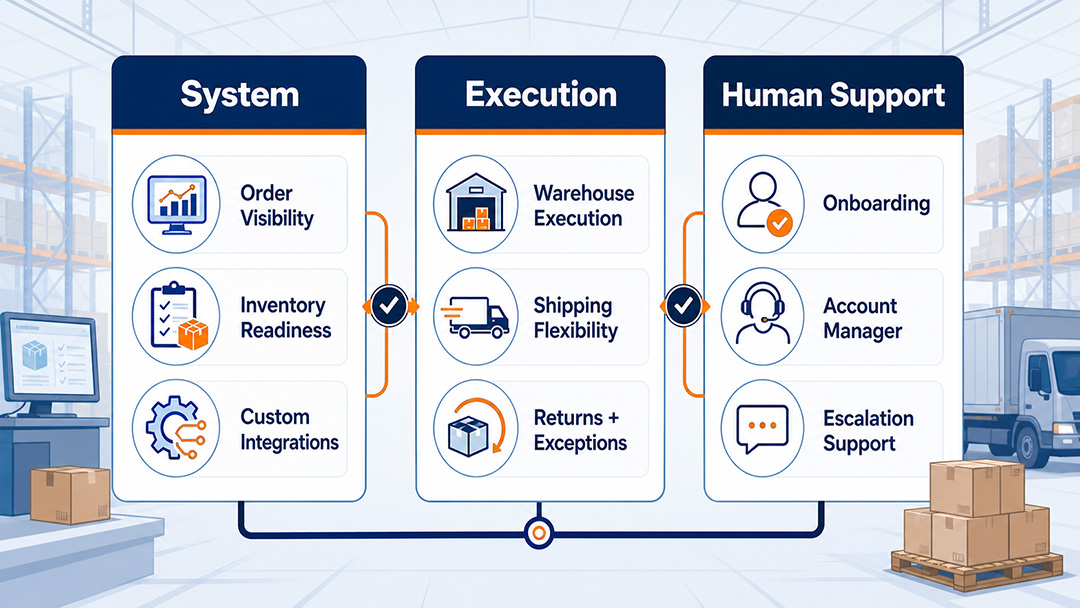
Useful questions include:
- How do orders enter the fulfillment workflow?
- Which sales channels and marketplaces can connect to the process?
- How are API and EDI order workflows handled?
- How are ERP integrations and custom integration needs evaluated?
- Can shipping-platform workflows such as ShipStation connect where needed?
- What visibility does the customer receive for inventory and order information?
- How are warehouse execution activities recorded?
- How are returns, damages, holds, and exceptions handled?
- How quickly do warehouse actions update the information available to the team?
- Can the 3PL support DTC fulfillment services, B2B fulfillment services, or both?
- Can the customer use the 3PL’s shipping accounts or provide its own labels?
- Can customer service support be added if the seller needs help managing ecommerce or marketplace communication?
- What happens when order data and warehouse reality do not match?
- Who helps investigate and resolve concerns?
The answers matter because a 3PL fulfillment partner is not only storing inventory.
It is helping your business turn customer demand into fulfilled orders.
That requires software, warehouse discipline, and human support working together.
The evaluation should leave you with a practical answer:
Can this partner help your business protect customer promises without turning every exception into a manual investigation?
How EOS-OMS and EOS-WMS Support Connected Fulfillment Execution
EOS supports fulfillment execution through a connected operating model.
EOS-OMS provides the customer-facing system layer. Customers access EOS-OMS through the client portal on the EOS website, using one login to view inventory, order status, returns visibility, operational visibility, and real-time tracking updates across applicable EOS facilities.
EOS-WMS supports the physical warehouse work that keeps inventory records accurate, including receiving, putaway, warehouse-order processing, picking, packing, returns, exceptions, and inventory movement across applicable EOS operations.
EOS warehouse teams use scan-supported workflows for receiving, putaway, picking, packing, returns, exceptions, and inventory movement. These scans support live operational tracking and accuracy verification.
EOS tracks inventory by warehouse location internally and performs regular cycle counts to help maintain inventory accuracy.
During onboarding, the EOS Account Manager learns the customer’s business model, logistics requirements, shipping preferences, returns policies, channel requirements, and workflow needs. EOS can then configure rules or policies to automate much of the repeatable order, shipping, and return workflow where configured.
Customers can review or modify system settings with their EOS Account Manager as their business changes.
Every EOS customer works with an EOS Account Manager who supports onboarding, workflow changes, communication, escalation, and concern resolution. The EOS Account Manager also represents the customer’s priorities internally, acting as an ambassador for the customer’s best interests so the relationship operates as a partnership rather than a purely transactional service.
Depending on the program, customers may use EOS shipping services or provide their own shipping labels.
That flexibility matters. Some customers want to leverage EOS parcel, trucking, LTL, and FCL transportation-account support and the shipping advantages that can come from EOS volume. Others already have customer-supplied labels, marketplace-provided labels, retailer routing requirements, or internal carrier accounts they need to keep using.
This model matters because fulfillment is not only a software problem.
Your business needs order visibility, inventory visibility, warehouse execution, transportation coordination, and people who know how to keep the work moving when standard workflows need attention.
How EOS Supports Returns, Marketplace Communication, and Customer Service Needs
Order management also affects what happens after the sale.
If a marketplace end customer contacts EOS about a return, EOS should direct the customer to process the return through the marketplace and contact the seller through the marketplace according to marketplace policy. That helps protect the customer experience while keeping the return inside the correct marketplace process.
For sellers that need more support, EOS can discuss customer service support during setup. This may be useful for international sellers, China-based customers, or marketplace brands that want English-language support, clearer customer communication, or more structured service workflows around ecommerce and marketplace channels.
This does not mean every seller needs EOS to handle customer service.
It means the workflow can be discussed during onboarding so the service model fits the customer’s business, language needs, channel expectations, and operational requirements.
For more context on warehouse-side return flow, see How Returns & Exception Handling Works in Warehouse Operations. The related EOS Returns & Exception Handling solution page explains how EOS supports return intake, exception handling, and resolution workflows.
When EOS May Not Be the Right Fit
EOS may not be the right fit for every business.
If order volume is still low, the inventory process is simple, and the business can manage fulfillment internally without strain, a lighter system or internal workflow may be enough.
EOS may also not be the right fit when a business only wants a standalone software subscription and does not need outsourced warehouse execution.
When EOS is not the right fit, we can still help clarify whether your business needs inventory software, an internally operated WMS, a specialized ecommerce platform, or another logistics model.
That qualification is important.
The goal is not to force every business into the most advanced model.
The goal is to understand which fulfillment model can support the work your business actually needs to control.
Conclusion: Fulfillment Needs Connected Order and Warehouse Control
OMS and WMS visibility matter because fulfillment sits between customer demand and physical execution.
The OMS helps organize the order. The WMS supports the warehouse work. The 3PL team executes the process, manages exceptions, supports transportation coordination where applicable, and helps keep the business informed.
The right 3PL fulfillment model connects those pieces.
For some businesses, that means building more internal system and warehouse capability. For others, it means choosing a fulfillment partner whose technology, warehouse teams, and support structure operate together.
If your business is evaluating 3PL fulfillment services because order flow, inventory visibility, returns, exceptions, transportation coordination, or warehouse execution have become harder to manage, EOS can help you evaluate the workflow and determine whether a connected fulfillment model is the right next step.
That is the resolution of the OMS series: the right system is not only the one that receives orders. It is the operating model that helps those orders become fulfillment-ready, executable, visible, and accountable.
This article also points toward two future topics. Transportation management deserves its own guide because order execution eventually has to connect to parcel, LTL, FCL, trucking, routing, and delivery coordination. The related EOS Transportation & Distribution solution page explains that connected transportation layer. Handheld PDA scanning also deserves its own guide because warehouse-floor verification is one of the ways system visibility stays connected to physical work.
Frequently Asked Questions
How do OMS and WMS support 3PL fulfillment services?
An OMS supports order flow and customer-facing order visibility. A WMS supports physical warehouse execution, including receiving, storage, scanning, picking, packing, returns, exceptions, and inventory movement. 3PL fulfillment services work best when both sides remain connected.
What does an OMS control in ecommerce fulfillment?
An OMS helps organize order intake, customer and shipping information, order status, fulfillment path coordination, exceptions, and the order visibility needed before warehouse execution begins.
What does a WMS control in warehouse fulfillment?
A WMS supports warehouse execution by helping control receiving, putaway, location tracking, inventory status, scanning, picking, packing, returns, exceptions, and inventory movement.
How do API and EDI fit into OMS and WMS workflows?
API and EDI workflows help order data enter the order management process. The OMS helps organize that order data, while the WMS supports the warehouse execution needed to fulfill the order accurately.
Which marketplaces and platforms can connect with EOS-OMS?
EOS supports direct, ShipStation-supported, ERP, API, and EDI-connected workflows where configured. Direct examples include Wayfair, eBay, and Walmart. ShipStation-supported examples include Shopify, Amazon, and WooCommerce. ERP-connected examples include Sellercloud. Other supported or configured workflows may also be available depending on the account requirements.
Can EOS build a custom integration?
Yes. If a customer needs a customized integration that is not already in place, EOS can evaluate, configure, or build custom integrations where required.
Why do order visibility and inventory visibility need to align?
Order visibility and inventory visibility need to align because customer promises depend on both. A business must know which orders need action and which inventory is actually ready to support those orders.
Can software alone fix fulfillment problems?
No. Software can support visibility, workflow, and coordination, but fulfillment also depends on warehouse execution, scanning discipline, process design, account support, and people who resolve exceptions when the standard workflow breaks.
What should a 3PL’s connected systems show your team?
A 3PL’s connected systems should help your team understand inventory availability, order progress, receiving updates, returns, exceptions, and operational activity that affects customer commitments.
When should a business consider EOS for 3PL fulfillment services?
A business should consider EOS when order flow, inventory readiness, warehouse execution, returns, exceptions, API or EDI order complexity, or multichannel fulfillment have become difficult to manage with basic software or internal workarounds.
How do EOS-OMS and EOS-WMS work together?
EOS-OMS provides customer-facing inventory, order, returns, operational, and real-time tracking visibility through one login across applicable EOS facilities.
EOS-WMS supports EOS warehouse execution, including receiving, putaway, warehouse-order processing, picking, packing, returns, exceptions, and inventory movement across applicable EOS operations.
Can customers use EOS shipping accounts or their own labels?
Depending on the program, customers may use EOS shipping services and EOS parcel, trucking, LTL, or FCL transportation-account support, or they may provide their own shipping labels when their customer, marketplace, retailer, or internal carrier account already supplies shipping.
Discover more from Enterprise Order Solutions
Subscribe to get the latest posts sent to your email.